Why Poor Inventory Software Is Draining Your Retail Profits
Retail profitability today is directly tied to inventory accuracy.
As retailers expand across e-Commerce, marketplaces, stores, mobile commerce, and omnichannel fulfilment networks, inventory complexity continues to rise. Yet many businesses still rely on disconnected inventory systems that were never designed for modern retail operations.
The result is operational inefficiency at scale.
Poor Inventory Management creates hidden financial leakage across the retail value chain through stock inaccuracies, fulfilment delays, excess inventory, markdowns, and lost sales opportunities.
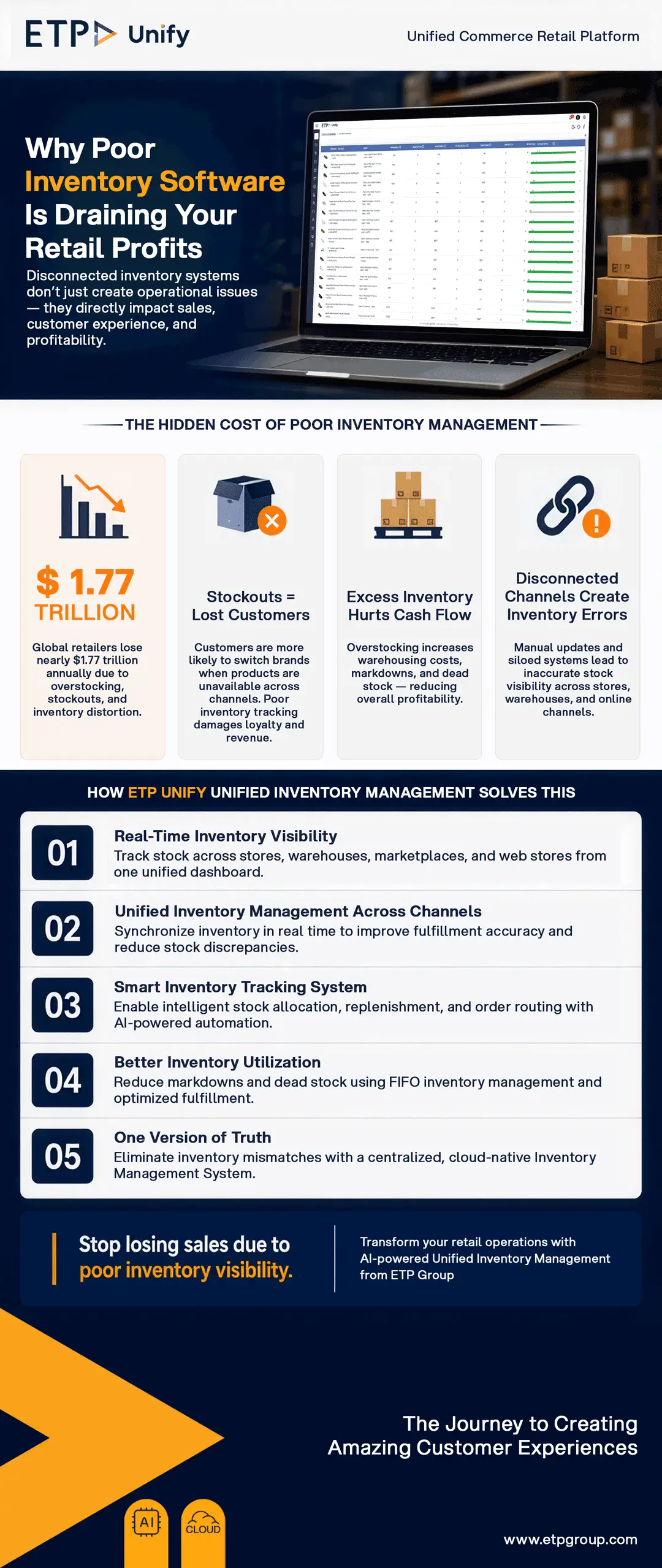
According to Deloitte Insights, inventory distortion caused by overstocks and out-of-stocks continues to cost retailers globally billions in lost revenue each year. For retailers across India, Southeast Asia, and APAC, fragmented inventory operations are becoming one of the biggest barriers to profitable growth.
Modern retail requires Unified Inventory Management that delivers real-time visibility, intelligent inventory allocation, and operational agility across all sales and fulfilment channels.
An advanced Inventory Management System is no longer just a back-office tool. It is a critical infrastructure for scalable unified commerce.
Why Inventory Complexity Has Increased in Modern Retail
Retail inventory management used to be relatively straightforward. Most retailers operated through:
- Physical stores
- Central warehouses
- Limited sales channels
- Predictable replenishment cycles
Today’s retail environment is significantly more dynamic.
Retailers now manage inventory across:
- e-Commerce websites
- Marketplaces
- Mobile commerce
- Retail stores
- Distribution centres
- Dark stores
- Third-party fulfilment providers
At the same time, customer expectations have changed dramatically.
Customers now expect:
- Real-time stock availability
- Faster delivery
- Flexible fulfilment options
- Accurate order updates
- Seamless cross-channel experiences
Retailers that rely on disconnected inventory systems often struggle with inaccurate stock visibility and delayed fulfilment decisions. Unified commerce platforms solve this challenge by creating a single, real-time inventory view across all channels.
Without real-time inventory intelligence, profitability suffers.
The Hidden Costs of Poor Inventory Management
Many retailers underestimate how much poor inventory systems impact financial performance. The operational costs often extend far beyond warehousing inefficiencies.
1. Lost Revenue from Stockouts
One of the biggest consequences of poor Inventory Tracking is lost sales due to unavailable stock.
When inventory systems fail to synchronise accurately across channels, retailers risk:
- Overselling
- Cancelled orders
- Customer dissatisfaction
- Reduced customer loyalty
According to McKinsey & Company, inventory visibility and fulfilment reliability play a major role in customer retention and repeat purchase behaviour.
Retailers that cannot expose accurate inventory availability often lose sales to competitors with stronger fulfilment capabilities.
2. Excess Inventory and Working Capital Pressure
Poor forecasting and fragmented inventory visibility frequently lead to overstocking.
Excess inventory creates several challenges:
- Increased carrying costs
- Higher warehousing expenses
- Product obsolescence
- Margin erosion through markdowns
- Cash flow inefficiencies
This is especially problematic for retailers operating across seasonal or trend-sensitive categories.
Unified Inventory Management helps retailers optimise stock allocation and improve inventory turnover across channels.
3. Inefficient Omni-Channel Fulfilment
Modern fulfilment models depend heavily on inventory accuracy.
Capabilities such as:
- Ship-from-store
- Click-and-collect
- Endless aisle
- Hyperlocal delivery
All require real-time inventory synchronisation.
Without a reliable Inventory Tracking System, retailers struggle to fulfil orders efficiently across distributed fulfilment networks.
Expert Commentary: Retailers that lack unified inventory visibility often experience slower fulfilment cycles, higher logistics costs, and operational inefficiencies across omni-channel operations.
4. Poor Customer Experience
Inventory inaccuracy directly impacts customer trust. Common customer experience issues caused by poor inventory systems include:
- Order cancellations
- Delayed deliveries
- Inaccurate stock availability
- Partial shipments
- Refund delays
Today’s customers expect seamless fulfilment experiences across all retail touchpoints.
A fragmented Online Inventory Management environment makes it difficult to deliver consistent service levels.
What Does Unified Inventory Management Solve?
Unified Inventory Management centralises inventory visibility and control across all retail operations. Instead of managing inventory separately across channels, retailers gain a single, real-time inventory view. This enables businesses to:
- Improve stock accuracy
- Reduce overselling
- Optimise fulfilment decisions
- Balance inventory dynamically
- Improve replenishment planning
- Support scalable omni-channel operations
For enterprise retailers, unified inventory visibility has become essential for operational resilience and long-term profitability.
Core Capabilities of a Modern Inventory Management System
A modern Inventory Management System should support far more than basic stock tracking.
Essential Inventory Management Capabilities
Real-Time Inventory Visibility
Synchronises stock availability across stores, warehouses, marketplaces, and e-Commerce channels.
Intelligent Inventory Allocation
Allocates inventory dynamically based on fulfilment priorities and customer demand.
Distributed Fulfilment Support
Enables ship-from-store, regional fulfilment, and omni-channel inventory orchestration.
Automated Replenishment
Uses inventory intelligence to improve replenishment planning and reduce stock imbalances.
Inventory Analytics and Reporting
Provides operational insights into inventory turnover, ageing stock, and fulfilment efficiency.
How ETP Unified Inventory Management Supports Retail Growth
As retail ecosystems become more connected, inventory orchestration becomes increasingly complex. This is where modern unified commerce platforms provide strategic value.
ETP Unify: Unified Inventory Management Solution helps retailers gain real-time inventory visibility across stores, warehouses, e-Commerce platforms, and marketplaces through a single unified platform.
By enabling intelligent inventory allocation and seamless omni-channel fulfilment, retailers can reduce operational inefficiencies while improving customer experience outcomes.
Inventory Management Evaluation Checklist for Retail Leaders
When evaluating an Inventory Management System, retail leaders should assess whether the platform supports:
Essential Inventory Management Checklist
- Real-time inventory synchronisation
- Centralised inventory visibility
- Omni-channel fulfilment support
- Distributed inventory management
- Marketplace integrations
- Automated replenishment
- Inventory analytics and reporting
- Cloud-native scalability
- API-driven integrations
- Regional scalability across APAC
Enterprise retailers increasingly prioritise inventory platforms that support unified commerce transformation and long-term operational agility.
Final Thoughts
Retail profitability is increasingly dependent on inventory intelligence.
As fulfilment expectations continue to rise, retailers need Unified Inventory Management capabilities that can deliver real-time visibility, operational agility, and scalable fulfilment orchestration across channels.
Poor inventory systems create hidden operational costs that impact revenue, customer experience, and long-term growth.
Modern Inventory Management Systems are no longer optional operational tools. They are strategic enablers of profitable unified commerce.
Retailers that invest in intelligent inventory orchestration today will be better positioned to improve fulfilment reliability, optimise working capital, and scale efficiently across modern retail ecosystems.
To learn how ETP Unified Inventory Management helps retailers modernise inventory operations and support unified commerce growth, connect with ETP experts.
Common Questions Retailers Ask
What is inventory management software in retail?
Inventory management software helps retailers track, manage, and optimise stock across stores, warehouses, e-Commerce platforms, and fulfilment channels. A modern Inventory Management System improves inventory visibility and supports efficient retail operations.
Can poor inventory software increase operational costs?
Yes, poor inventory software can increase operational costs through stock inaccuracies, excess inventory, order cancellations, fulfilment delays, and inefficient replenishment processes. Fragmented Inventory Tracking systems often lead to lost sales and reduced operational efficiency.
How can modern inventory management software improve efficiency?
Modern Unified Inventory Management software improves efficiency by providing real-time inventory visibility, automated stock synchronisation, intelligent replenishment, and streamlined fulfilment operations. This helps retailers reduce manual errors, optimise inventory allocation, and improve customer experience across channels.
- Cara menyatukan toko online dan toko fisik Anda menjadi satu pengalaman pelanggan yang terpadu (tanpa harus repot menghabiskan berbulan-bulan untuk proses integrasi).
- Memanfaatkan wawasan berbasis kecerdasan buatan (AI) untuk mengelola persediaan, mengurangi limbah, dan memaksimalkan penjualan di seluruh saluran.
- Contoh nyata tentang bagaimana platform ETP saat ini memberikan peningkatan efisiensi yang terukur dan lonjakan pendapatan yang signifikan bagi para pengecer terkemuka.