Philippine Retail Is Entering a New Growth Phase
The Philippine retail industry has always been resilient. Today, however, resilience alone is no longer enough.
Consumers now move effortlessly between physical stores, brand websites, online marketplaces, and social commerce platforms. They may discover a product on social media, compare prices on a marketplace, purchase through an e-Commerce site, and choose to collect it from a nearby store—all within a single shopping journey.
At the same time, retailers are expanding into new digital channels to capture this demand. According to Euromonitor, retail e-Commerce in the Philippines continues to record double-digit growth, driven by rising smartphone adoption, improving logistics infrastructure, and increasing consumer confidence in online shopping.
Yet despite this rapid expansion, many retail businesses still rely on disconnected systems to manage stores, online channels, inventory, orders, and customer data.
This creates operational complexity that becomes more difficult—and more expensive—to manage as the business grows.
The next phase of Philippine retail won't be defined by how many channels a retailer operates. It will be defined by how well those channels work together.
Quick Summary
Retailers preparing for the future should focus on:
- Connecting physical and digital commerce
- Creating real-time inventory visibility
- Eliminating operational silos
- Automating order fulfilment
- Delivering consistent customer experiences
- Building a scalable unified commerce strategy
Why More Sales Channels Aren't Solving Retail Complexity
Launching an online store is relatively easy.
Adding a marketplace is straightforward.
Selling through social commerce is becoming increasingly common.
Managing all of them together is where complexity begins.
Many retailers continue adding new sales channels without modernising the technology supporting them.
The result is fragmented operations.
Common challenges include:
- Different inventory records across channels
- Manual stock updates
- Multiple order management processes
- Separate customer databases
- Inconsistent promotions
- Limited operational visibility
Each new channel increases revenue opportunities but also introduces another layer of operational complexity.
What Challenges Do Disconnected Retail Systems Create?
When systems don't communicate, every department experiences the impact.
Inventory becomes unreliable
One system may show products in stock while another reports them as unavailable.
This leads to:
- Overselling
- Stockouts
- Excess inventory
- Lost sales opportunities
Teams spend more time reconciling data
Instead of analysing business performance, employees spend hours updating spreadsheets and correcting discrepancies.
Customers receive inconsistent experiences
A customer expects the same pricing, promotions, loyalty benefits, and product availability regardless of where they shop.
Disconnected systems make consistency difficult.
Decision-making slows down
Retail leaders cannot respond quickly because information is spread across multiple platforms.
By the time reports are consolidated, the opportunity has often passed.
Expert Insight: Retailers operating disconnected commerce systems often struggle with inaccurate inventory, delayed fulfilment, and fragmented customer experiences. A unified commerce approach creates a single source of truth that enables faster and more confident business decisions.
Why Is Unified Commerce Becoming Essential?
Many retailers believe omnichannel simply means selling across multiple channels.
In reality, omnichannel focuses on customer touchpoints.
Unified commerce connects every operational layer behind those touchpoints.
That includes:
- Stores
- e-Commerce
- Marketplaces
- Warehouses
- Inventory
- Orders
- Customer information
- Promotions
Instead of operating independently, these functions share one connected platform and one consistent data source.
According to Deloitte, unified commerce integrates front-end customer experiences with back-end retail operations, providing retailers with richer data, greater visibility, and the ability to deliver seamless shopping experiences across every channel.
What Does a Unified Commerce Strategy Look Like?
A modern unified commerce strategy focuses on creating connected operations rather than adding disconnected technology.
Unified Inventory Management
Inventory is updated across every sales channel in real time.
Retailers gain accurate stock visibility across stores, warehouses, and online channels.
Benefits include:
- Reduced stockouts
- Better replenishment planning
- Improved inventory utilisation
Smart Order Management
Orders are intelligently routed based on inventory availability, fulfilment location, delivery timelines, and operational priorities.
This helps retailers:
- Improve fulfilment speed
- Lower shipping costs
- Increase order accuracy
Marketplaces & e-Commerce Integrations
Rather than managing every marketplace independently, retailers operate from a single platform.
Products, pricing, promotions, and inventory remain synchronised across channels.
Cloud Native Retail Software
As retail businesses grow, technology must scale alongside them.
Cloud-native retail software allows retailers to:
- Expand into new markets faster
- Launch additional stores efficiently
- Support higher transaction volumes
- Reduce infrastructure complexity
Checklist: Is Your Retail Business Ready?
Ask yourself these questions:
- Can every store view inventory across all locations?
- Are online and offline inventory records synchronised?
- Can orders be fulfilled from multiple locations?
- Are customer records unified across every channel?
- Can promotions be managed centrally?
- Do executives receive real-time operational insights?
- Can your current retail software support future expansion?
If several answers are "No," it may be time to rethink your retail technology foundation.
The Next Phase of Philippine Retail Is About Connected Operations
Retail growth in the Philippines shows no signs of slowing.
Consumers will continue adopting new shopping behaviours.
Digital channels will continue expanding.
Marketplaces and social commerce will continue growing.
The retailers that thrive won't necessarily be those with the most stores or the most online channels.
They will be the retailers that operate with connected, intelligent, and data-driven retail systems.
Growth becomes sustainable when every part of the business works together—not separately.
Future-Proof Retail Growth with ETP Unify
ETP Unify is a cloud-native Unified Commerce platform that helps retailers connect stores, inventory, orders, customers, and fulfilment into one intelligent ecosystem.
With capabilities including Unified Inventory Management, Smart Order Management, Cloud POS, Retail CRM, and Marketplaces & e-Commerce Integrations, ETP Unify gives retailers the visibility and agility needed to scale confidently while delivering seamless customer experiences.
Whether you're expanding across physical stores, online channels, or marketplaces, ETP Unify helps create the operational foundation for long-term retail growth.
Ready for the Next Phase of Philippine Retail?
The future belongs to retailers with connected commerce, not disconnected systems.
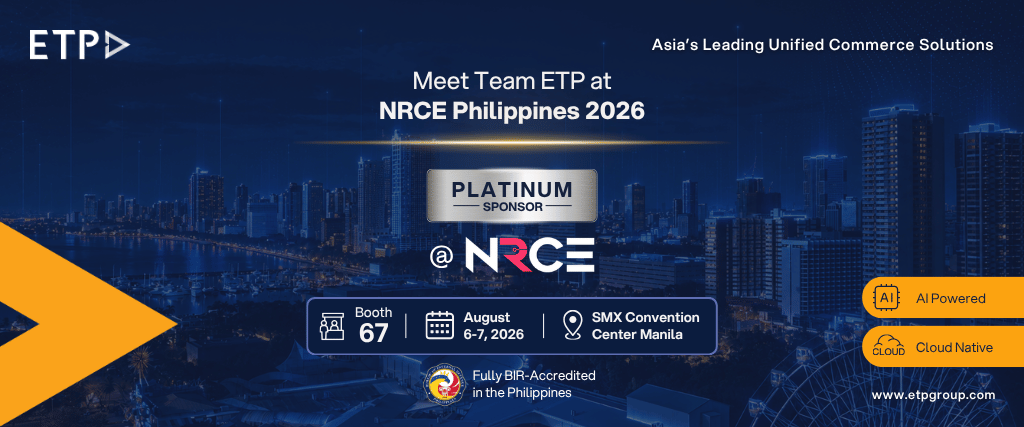
Meet the ETP team at Booth 67 during NRCE Philippines 2026 to discover how ETP Unify helps retailers simplify operations, improve customer experiences, and scale with confidence.
Book a personalised demo and see Unified Commerce in action.
Common Questions Retailers Ask
What is Unified Commerce?
Unified commerce is a retail operating model where stores, e-Commerce, marketplaces, inventory, orders, customers, and fulfilment are managed through one integrated platform and a single source of truth.
How is Unified Commerce Different from Omni-channel Retail?
Omnichannel retail focuses on providing customers with multiple shopping channels.
Unified commerce connects the systems behind those channels, ensuring data, inventory, orders, and customer information remain synchronised.
Why Is Real-Time Inventory Visibility Important?
Accurate inventory visibility enables retailers to:
- Reduce stockouts
- Prevent overselling
- Improve fulfilment accuracy
- Optimise replenishment
- Deliver better customer experiences