Omni-Channel Fulfilment: How to Reroute Orders from Busy Stores
An online order arrives at a retail store for fulfilment. The store team is already handling a long queue of customers, processing returns and preparing several other online orders. Adding another order to the queue could delay dispatch and affect the delivery commitment made to the customer.
But the retailer has other options. Another nearby store may have the same product in stock and the capacity to process the order. A warehouse may also be able to fulfil it within the required delivery window.
The question is how quickly the retailer can identify an alternative and redirect the order.
This is where omni-channel order fulfilment and intelligent order rerouting become important. Instead of relying on one location to fulfil every assigned order, retailers can use a connected fulfilment network to identify alternative locations based on inventory availability, proximity, delivery commitments and predefined business rules.
For retailers operating multiple stores, warehouses and e-commerce channels, this capability can help manage fulfilment bottlenecks while keeping orders moving.
Why Do Busy Stores Become Fulfilment Bottlenecks?
Physical stores are increasingly part of retailers' online fulfilment networks. Through models such as Ship-from-Store, Buy Online, Pick Up In-Store (BOPIS) and Click & Collect, stores can fulfil orders originating from digital channels.
However, adding fulfilment responsibilities to existing store operations introduces new demands.
A store associate may need to serve walk-in customers, replenish shelves, process transactions, handle exchanges and prepare online orders within the same shift.
When several activities compete for attention, fulfilment can become difficult to manage.
Some common situations include:
- High online order volumes: A store receives more online orders than its team can process within the expected timeframe.
- Limited store staffing: The available team is occupied with customer-facing activities, leaving fewer resources for picking and packing orders.
- Inventory discrepancies: The system indicates that a product is available, but the store team cannot locate it on the shelf.
- Delayed order processing: Orders remain pending because store associates cannot accept or prepare them quickly enough.
- Delivery commitments at risk: The assigned store may not be able to dispatch an order within the promised delivery window.
When these situations occur, continuing to assign orders to the same location can create further delays.
Retailers need a way to identify alternative fulfilment locations before a delay becomes a customer-facing problem.
What Is Order Rerouting in Omni-Channel Fulfilment?
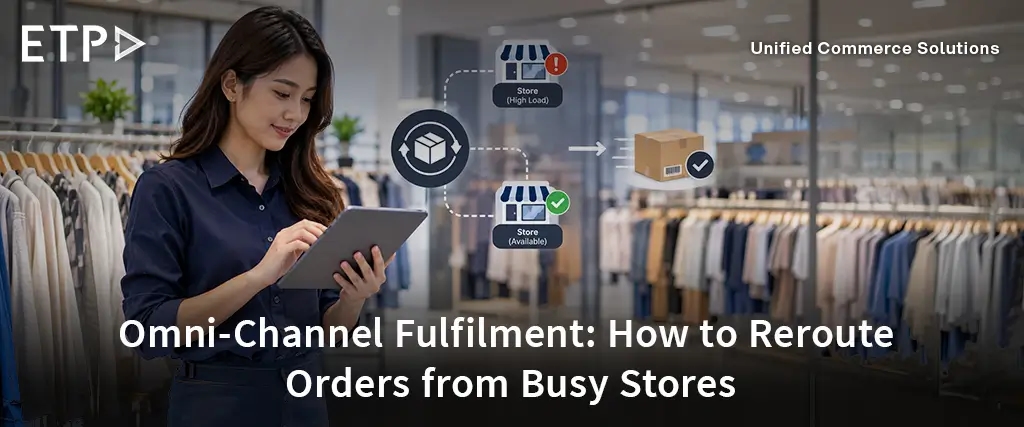
Order rerouting is the process of redirecting an order from its initially assigned fulfilment location to another eligible location.
For example, a customer places an online order for a product. The order management system initially assigns it to Store A because the product is available there and the location is close to the customer.
However, Store A is experiencing high order volumes and cannot process the order within the required delivery timeframe.
The retailer may redirect the order to Store B, which has available inventory and can fulfil it within the delivery commitment.
The order continues through the fulfilment process without depending on the original location.
Depending on the retailer's operating model, alternative fulfilment locations could include:
- Another nearby retail store.
- A central warehouse.
- A regional distribution centre.
- A dark store or another eligible fulfilment node.
The objective is to find an alternative that can fulfil the order while meeting the retailer's operational rules and customer commitments.
How Does Intelligent Order Rerouting Work?
Order rerouting involves more than changing the fulfilment location. The system needs to evaluate available inventory, fulfilment eligibility and delivery requirements before making another allocation.
Here is how the process typically works.
1. An Order Is Received and Assigned to a Fulfilment Location
A customer places an order through an e-commerce website, marketplace or another sales channel.
The order management system receives the order and evaluates available fulfilment locations.
The initial allocation may consider:
- Product availability.
- Customer location.
- Distance to the delivery destination.
- Delivery SLA.
- Fulfilment mode.
- Retailer-defined business rules.
The system then assigns the order to an eligible store or warehouse.
2. The Assigned Store Encounters a Fulfilment Constraint
Once the order reaches the store, the team may discover that it cannot be processed as expected.
For instance, the store could be handling several pending online orders, the product may not be physically available, or the team may be unable to meet the required dispatch timeframe.
If the location cannot fulfil the order, the retailer needs to initiate an exception or reallocation process.
This is an important stage. A retailer should be able to identify fulfilment problems early rather than wait until the delivery commitment has already been missed.
3. The System Identifies Alternative Fulfilment Locations
The order management system evaluates other eligible locations using available inventory information and predefined routing criteria.
For example:
- Is the product available at another store?
- Is the inventory sufficient to fulfil the order?
- Can the alternative location meet the delivery SLA?
- Is the location eligible for the selected fulfilment mode?
- Does the proposed allocation comply with the retailer's business rules?
These checks help narrow down the available options.
4. The Order Is Reassigned
Once an alternative location is identified, the order can be reallocated according to the retailer's routing rules.
The new fulfilment location receives the order and proceeds with the required processing activities.
This may include order acceptance, picking, packing, labelling and shipping.
The original allocation needs to be handled appropriately to avoid duplicate processing or inventory commitments.
5. The Order Continues Through Fulfilment
After reassignment, the order proceeds through the updated fulfilment workflow.
The retailer should maintain visibility into the order's progress, including its current fulfilment location and processing status.
Customer-facing delivery commitments and notifications should also reflect the updated fulfilment arrangement where necessary.
The aim is to manage the change without creating confusion for the customer or store teams.
Also read: Omni-channel Fulfillment Strategy for Retail
What Factors Should Retailers Consider When Rerouting Orders?
Not every alternative store is automatically the right choice.
A location may have the required product but be too far away to meet the delivery commitment. Another may be closer but have insufficient available inventory.
Retailers need routing rules that consider multiple factors rather than relying on proximity alone.
| Routing factor | Why it matters |
|---|---|
| Real-time stock availability | Confirms whether the alternative location has sufficient inventory. |
| Customer proximity | Helps identify locations closer to the delivery destination. |
| Delivery SLA | Ensures the alternative can meet the required delivery timeframe. |
| Fulfilment mode | Determines whether the location supports shipping, pickup or other fulfilment options. |
| Business rules | Ensures routing decisions follow retailer-defined priorities and restrictions. |
| Location eligibility | Helps identify which stores, warehouses or fulfilment nodes can process the order. |
Retailers should also consider operational capacity when designing their routing strategy. Store workload, staffing availability and pending order volumes can influence whether a location is suitable for fulfilment.
However, these operational factors need to be supported by the retailer's system configuration and available data. They should not be assumed to be automatically evaluated by every order management platform.
A Practical Example: Rerouting an Order from a Busy Store
Consider a fashion retailer operating multiple stores and a central warehouse.
A customer places an online order for a pair of shoes. The order is initially assigned to Store A because the required size is available and the store is close to the customer's delivery address.
However, Store A is handling a high volume of online orders and cannot prepare the new order within the expected timeframe.
The retailer's order management process identifies the fulfilment issue and evaluates alternative locations.
Illustrative scenario. The locations and figures below are hypothetical.
| Fulfilment detail | Store A | Store B | Central warehouse |
|---|---|---|---|
| Available inventory | 4 units | 8 units | 25 units |
| Distance from customer | 3 km | 7 km | 15 km |
| Current workload | High | Moderate | Normal |
| Estimated processing time | 5 hours | 1 hour | 2 hours |
| Delivery commitment | At risk | Achievable | Achievable |
Although Store A is the closest location, its current workload makes it a less suitable choice.
Store B has sufficient stock and can process the order sooner. The retailer can therefore consider reallocating the order to Store B, provided the alternative meets the applicable routing and delivery rules.
This illustrates an important point about order orchestration.
The closest location is not always the most appropriate fulfilment location. Retailers need to consider inventory, service commitments and operational requirements together.
How Does Order Rerouting Improve Retail Fulfilment?
When implemented with appropriate inventory visibility and routing rules, order rerouting can help retailers manage several operational challenges.
Reduces Dependence on Individual Stores
When a store experiences high order volumes or cannot fulfil an order, the retailer can consider other eligible locations.
This distributes fulfilment demand across the wider network instead of placing the entire responsibility on one store.
Helps Protect Delivery Commitments
An order that cannot be processed at its original location may still be fulfilled elsewhere.
Evaluating alternative locations against delivery SLAs gives retailers another way to manage orders that are at risk of delay.
Makes Better Use of Distributed Inventory
Retailers often hold inventory across multiple stores and warehouses.
A connected order management system helps make this inventory available for fulfilment decisions rather than limiting orders to the stock assigned to one location or channel.
Improves Visibility into Fulfilment Exceptions
Order rerouting requires retailers to identify when an assigned location cannot complete an order.
This creates an opportunity to manage exceptions through a defined process instead of relying entirely on manual follow-ups between store and central operations teams.
Supports More Flexible Fulfilment Operations
As retailers add stores, warehouses and new sales channels, fulfilment requirements become more complex.
Intelligent routing and re-routing help retailers coordinate orders across a distributed network.
What Should Retailers Look for in an Order Management System?
A retail order management system should support the entire order lifecycle, including initial allocation, fulfilment processing, rerouting and exception handling.
When evaluating solutions, retailers should consider the following capabilities.
1. Intelligent order routing and re-routing
The system should support allocation and reallocation based on inventory availability, location, delivery SLAs and business rules.
2. Real-time inventory visibility
Retailers need accurate inventory information across stores, warehouses and other fulfilment locations to make informed routing decisions.
3. Centralised order orchestration
Orders originating from e-commerce websites, marketplaces and other channels should be manageable through a centralised order management framework.
4. Distributed fulfilment support
The solution should support eligible stores, warehouses and other fulfilment nodes as part of the retailer's network.
5. Order processing workflows
Store and warehouse teams should be able to manage activities such as order acceptance, picking, packing, labelling and shipping.
6. Exception management
The system should help retailers manage rejected orders, inventory discrepancies, cancellations and other fulfilment disruptions.
7. Integration with retail systems
Order management should connect with e-commerce platforms, ERP systems, inventory management, POS and logistics partners to maintain consistency across operations.
8. Fulfilment performance visibility
Retailers should be able to monitor order status, fulfilment delays, exceptions and service-level performance.
Together, these capabilities provide the operational foundation for managing orders across multiple fulfilment locations.
How ETP Unify Supports Intelligent Order Rerouting
ETP Unify's Omni-Channel Fulfillment solution connects physical and digital retail operations through a unified fulfilment network.
Its Smart Order Management capability supports AI-driven order routing and re-routing, helping retailers dynamically route and reallocate orders based on:
- Real-time stock availability.
- Location.
- Service-level agreements.
- Delivery mode.
- Predefined business rules.
This allows retailers to manage fulfilment decisions across stores, warehouses and other eligible fulfilment locations.
The platform also supports centralised order orchestration and workflows covering order acceptance, picking, packing, labelling, shipping and exception management.
For retailers dealing with busy stores or changing fulfilment requirements, the ability to reallocate orders provides an alternative when the initially assigned location cannot complete the order.
Beyond order routing, ETP Unify supports fulfilment journeys such as BOPIS, Click & Collect, Click & Deliver, ROPIS and Endless Aisle.
Its real-time inventory visibility across stores, warehouses, dark stores and partners helps retailers make fulfilment decisions using a consolidated view of available stock.
By connecting order management with inventory and fulfilment operations, retailers can manage orders as part of a wider network rather than treating each store as an independent fulfilment point.
Conclusion
A busy store should not necessarily become a bottleneck for the retailer's entire fulfilment network.
When an assigned location cannot process an order, retailers need a way to identify alternatives, evaluate inventory availability and redirect the order without losing visibility into its progress.
Intelligent order routing and re-routing make this possible by connecting orders with eligible fulfilment locations across stores and warehouses.
For retailers managing growing online order volumes, investing in connected order management capabilities can help create a more flexible fulfilment operation.
Discover how ETP Unify's Smart Order Management can help you coordinate orders and re-route fulfilment across your retail network. Let’s Talk!
Common Questions Retail Leaders Ask
1. What is order rerouting in retail?
Order rerouting is the process of redirecting an order from its initially assigned fulfilment location to another eligible store, warehouse or fulfilment centre. It is used when the original location cannot fulfil the order or when another location is more suitable based on inventory, delivery requirements and business rules.
2. Why do retailers need intelligent order routing?
Intelligent order routing helps retailers determine where orders should be fulfilled based on factors such as inventory availability, customer proximity, delivery SLAs and predefined business rules. It helps coordinate orders across multiple stores and warehouses.
3. Can an order management system reroute orders automatically?
Yes, order management systems with automated routing and re-routing capabilities can reallocate orders based on configured criteria and operational information. The exact triggers and rules depend on the platform and retailer's configuration.
4. What is the difference between order routing and order rerouting?
Order routing is the initial process of assigning an order to a fulfilment location. Order rerouting happens when an existing allocation needs to change, directing the order to another eligible location.
5. How does real-time inventory visibility support order rerouting?
Real-time inventory visibility helps the system identify alternative locations with available stock. This information is important when evaluating whether another store or warehouse can fulfil an order.
- 如何将您的线上商店和实体店整合为一个统一、连贯的客户体验(无需经历长达数月的系统集成烦恼)。
- 利用AI驱动的洞察力来管理库存、减少浪费,并最大限度地提高各渠道的销售额。
- ETP平台目前如何为领先零售商带来可量化的效率提升和显著的营收增长,以下是一些实际案例。