Inventory is where retail profits are made or lost. Too much stock locks up cash and drives markdowns. Too little stock leads to missed sales and unhappy customers. Somewhere in between is the balance every retailer is chasing.
But here’s the reality: managing inventory today is far more complex than it used to be. Products move across stores, warehouses, online channels, and marketplaces. Customers expect accuracy in real time. And leadership teams expect inventory to support growth, not slow it down.
That’s why Inventory Management for Retail has shifted from spreadsheets and siloed systems to cloud-based, connected platforms. The retailers that get this right don’t just control stock. They unlock profitability and scale.
Why Inventory Management for Retail Is a Profit Lever
Inventory isn’t just an operational concern. It’s a financial one.
Every unit sitting unsold represents tied-up capital. Every stockout represents lost revenue and customer trust. Effective inventory management for retail directly impacts:
- Gross margins
- Cash flow
- Sell-through rates
- Customer satisfaction
- Store productivity
Retailers that treat inventory as a strategic asset, not just a back-office function, are the ones that scale profitably.
The challenge is doing this across multiple stores, channels, and fulfillment models without losing control.
The Role of Cloud POS in Modern Inventory Control
A Cloud POS is often the starting point for better inventory management. Why? Because POS is where inventory truth begins.
Every sale, return, and exchange updates stock levels. When your POS runs on the cloud, those updates happen in real time across the business.
This gives retailers:
- Instant visibility into store-level inventory
- Centralized stock updates across locations
- Fewer mismatches between physical and system stock
- Faster replenishment decisions
Traditional POS systems update inventory locally and sync later, creating gaps and delays. Cloud POS eliminates that lag, making inventory data reliable and actionable.
Cloud Based Inventory Management vs Legacy Systems
Legacy inventory systems were designed for slower retail cycles. Weekly updates. Manual reconciliations. Heavy dependence on back-office teams.
Cloud based inventory management works differently.
It’s always on. Always connected. Always current.
Key advantages include:
- Real-time stock visibility across stores and warehouses
- Automatic updates from POS, e-Commerce, and OMS
- Centralized control without store-level IT dependency
- Faster response to demand changes
For retailers managing multiple channels, cloud-based inventory is no longer optional. It’s the only way to keep pace with customer expectations.
Cloud Native Inventory Management for Omni-channel Retail
Omni-channel retail breaks traditional inventory logic. Stock isn’t just “store stock” or “warehouse stock” anymore. It’s one shared pool that needs to be allocated intelligently.
This is where cloud native inventory management becomes critical.
A cloud native system is built from the ground up to:
- Handle high transaction volumes
- Support real-time APIs and integrations
- Scale across regions and brands
- Adapt to new fulfillment models quickly
Unlike retrofitted legacy software, cloud native inventory platforms are designed for complexity. They support scenarios like ship-from-store, buy online pick up in store, endless aisle, and marketplace fulfillment without breaking inventory accuracy.
Using POS and Inventory Software as a Single System
One of the biggest mistakes retailers make is treating POS and inventory as separate systems. When they don’t talk to each other seamlessly, errors multiply.
Modern POS and inventory software works as a single ecosystem.
Benefits include:
- Sales instantly reflect in inventory counts
- Returns update stock availability in real time
- Promotions don’t distort inventory data
- Store and online teams work from the same numbers
This tight integration reduces reconciliation work, improves forecasting, and ensures customers see accurate availability wherever they shop.
Stock and Inventory Management Software That Reduces Risk
Risk in retail inventory shows up in many forms: dead stock, shrinkage, overstocks, and missed demand.
Good stock and inventory management software helps retailers reduce these risks by:
- Tracking stock movement at SKU level
- Highlighting slow-moving and fast-moving items
- Supporting cycle counts and audits
- Flagging anomalies early
When inventory data is clean and timely, decision-making improves. Merchandising teams can adjust assortments. Operations teams can rebalance stock. Finance teams can plan cash flow with confidence.
Inventory Strategies That Actually Scale
Technology alone doesn’t fix inventory problems. Strategy matters.
Here are proven inventory strategies that work best when supported by cloud-based systems:
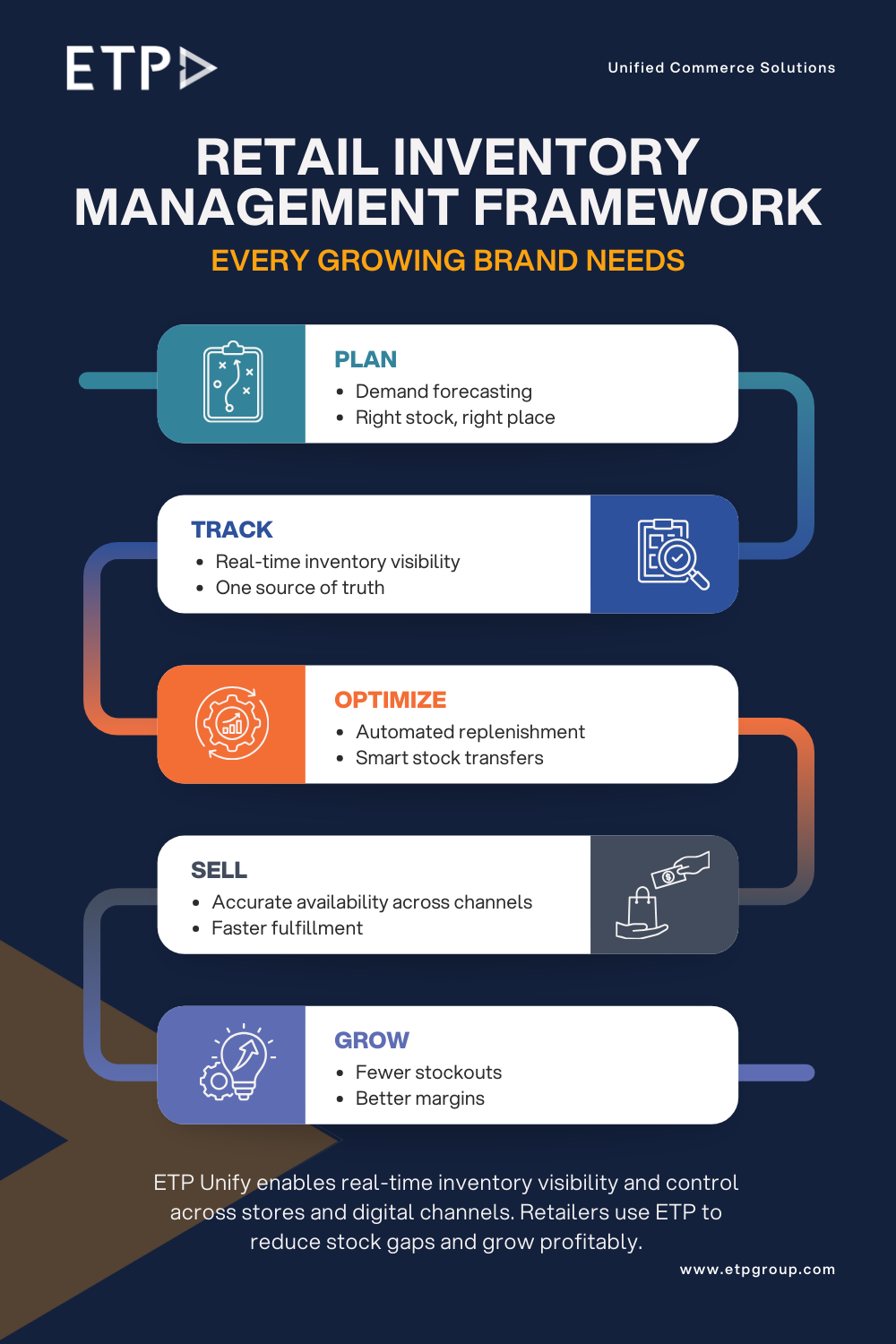
- Centralized inventory visibility
Treat inventory as one shared pool across channels and locations. - Demand-driven replenishment
Use real-time sales data to drive replenishment instead of static forecasts. - Store-as-fulfillment-node
Leverage store inventory to fulfill online demand and reduce last-mile costs. - Continuous inventory accuracy
Adopt cycle counting and real-time updates instead of periodic stock checks. - Data-led assortment planning
Use historical and live data to optimize SKU mix by store and channel.
These strategies only work when inventory systems can support speed, scale, and accuracy.
The Link Between Inventory Management and Customer Experience
Customers don’t think about inventory systems. But they feel the impact immediately.
Strong inventory management enables:
- Accurate “in stock” messages online
- Faster fulfillment promises
- Fewer cancelled orders
- Better availability in stores
- Smoother returns and exchanges
When inventory data is wrong, trust erodes fast. When it’s right, customers shop with confidence.
That’s why inventory management is as much a customer experience investment as it is an operational one.
ETP Unify Inventory Management: Connected, Scalable, and Real-Time
When retailers think about inventory today, it can’t live in isolation from the systems that run stores, orders, and customer experiences. That’s exactly where ETP Unify makes a difference.
ETP Unify brings together Cloud POS and unified inventory management into a single, cloud-native platform that keeps stock levels accurate and operations streamlined across every channel. Because the POS and inventory are tightly integrated, every sale, return, or stock adjustment updates the central system in real time, eliminating discrepancies and giving leaders one version of truth for inventory across stores, warehouses, and online touchpoints.
Beyond visibility, ETP Unify enables smarter stock decisions. Store associates and planners can see real-time inventory availability directly at checkout or in dashboards, which improves fulfillment accuracy and reduces stockouts. Its cloud-native inventory backbone also supports cross-channel fulfilment like click & collect and endless aisle, connecting physical and digital demand without dead stock or split-stock confusion.
What this really means for retailers is clearer control and less guesswork. Inventory isn’t just tracked, it’s managed intelligently, tied to POS activity, and ready to scale as your business grows. With ETP Unify, retail teams get the tools they need to drive profitability, reduce waste, and keep customers coming back for more.
Also read Key steps to achieve unified inventory management across your business
Schedule a call with our team to know more: Lets Connect
How does technology improve retail inventory management?
Technology improves retail inventory management by using cloud native inventory management and pos and inventory software to provide real-time data, automate stock updates, and reduce manual errors across stores and online channels.
Can inventory management systems support retail scalability?
Yes, modern stock and inventory management software built on cloud based inventory management allows retailers to scale easily by supporting multiple stores, higher order volumes, and new fulfillment models without losing control.