Unified CRM Systems: The Key to Personalized Retail Experiences
Retail customer expectations have fundamentally evolved.
Today’s consumers expect retailers to understand their preferences, recognise their purchase behaviour, and deliver consistent experiences across every interaction point. Whether customers engage through stores, e-Commerce platforms, marketplaces, mobile apps, or social commerce channels, they expect personalization to feel seamless and connected.
However, many retailers still operate with fragmented customer and transaction systems that create disconnected experiences. Customer data often sits across:
- POS systems
- e-Commerce platforms
- Loyalty programs
- Customer service tools
- Marketing platforms
- Marketplace ecosystems
This fragmentation makes it difficult to create a unified customer experience.
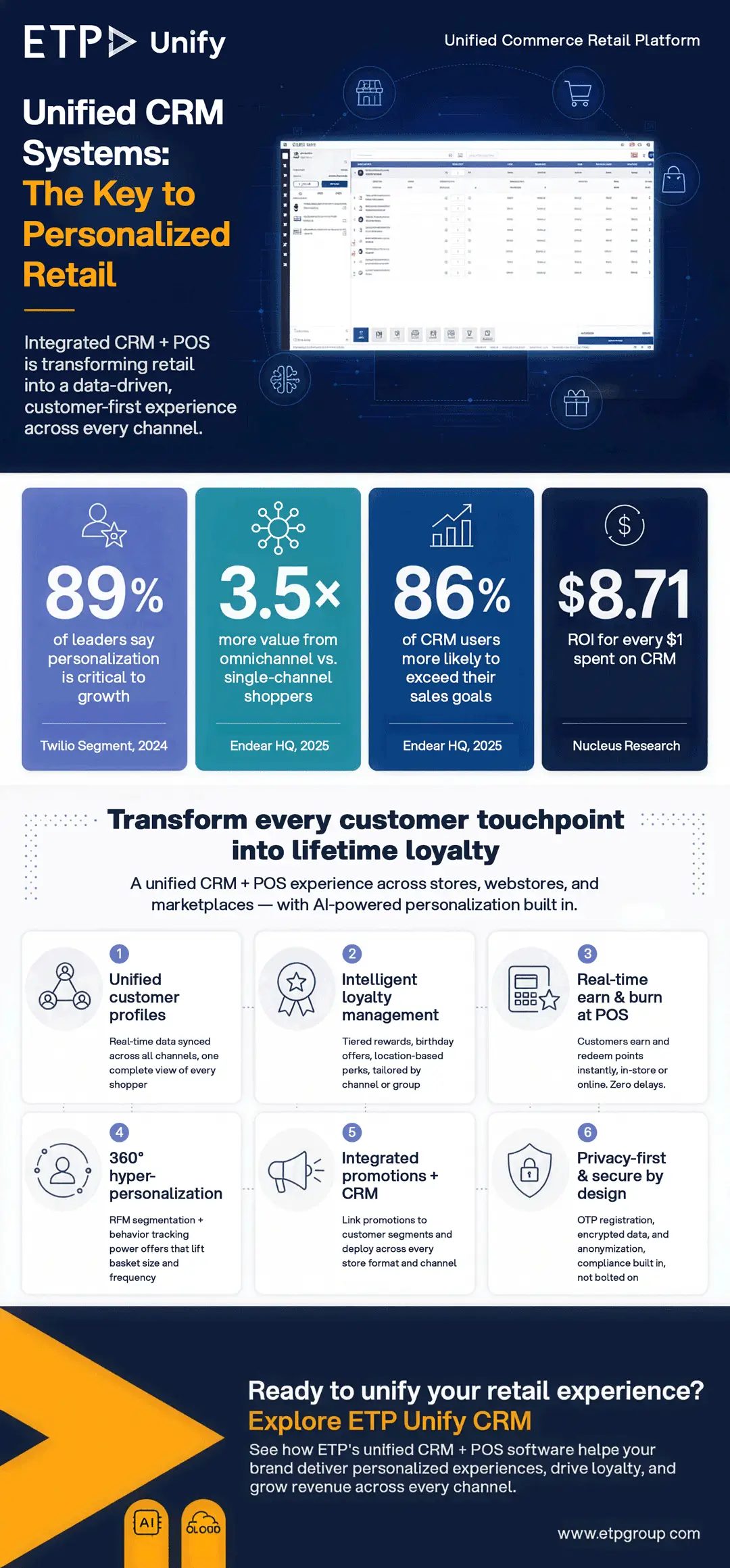
As retail competition intensifies across India, Southeast Asia, and APAC, personalized commerce is increasingly becoming a major differentiator. This is why retailers are investing in Unified CRM Systems integrated with Unified POS software to create a single customer view across all channels.
Modern CRM Management POS capabilities are no longer limited to customer databases. They are becoming central to unified commerce transformation.
Why Unified CRM Matters in Modern Retail
A modern CRM System helps retailers:
- Centralise customer data across channels
- Personalize customer experiences
- Improve customer retention and loyalty
- Enable targeted marketing campaigns
- Create seamless omni-channel journeys
- Improve store associate productivity
- Enhance customer service interactions
- Increase customer lifetime value
For enterprise retailers, unified customer intelligence has become essential for profitable growth.
Why Traditional CRM Systems No Longer Meet Retail Needs
Legacy CRM environments were built for simpler retail ecosystems. Most traditional CRM systems were designed around:
- Limited customer touchpoints
- Store-centric transactions
- Basic loyalty programs
- Isolated customer records
Modern retail operates very differently.
Today’s customers interact across multiple channels before making a purchase decision. A single customer journey may involve:
- Browsing online
- Visiting a physical store
- Checking marketplace listings
- Using mobile apps
- Interacting with loyalty programs
- Engaging with customer support
Retailers that rely on disconnected systems often struggle to create consistent customer experiences because customer data remains fragmented across channels. Unified commerce platforms solve this by creating a single customer profile connected to inventory, fulfilment, and transaction systems.
Without unified customer intelligence, personalization becomes difficult to scale.
The Growing Importance of Personalization in Retail
Personalization is no longer a marketing advantage. It is a customer expectation.
According to McKinsey & Company, consumers increasingly expect personalized interactions across every stage of the shopping journey, and retailers that deliver personalization effectively often improve customer engagement and retention significantly.
Retailers across APAC are seeing increasing demand for:
- Hyper-personalized promotions
- Real-time recommendations
- Personalized loyalty experiences
- Context-aware customer service
- Seamless cross-channel shopping experiences
This requires a unified customer data infrastructure supported by modern CRM Management POS management platforms.
How Unified CRM Systems Improve Retail Experiences
A Unified CRM System centralises customer interactions, transaction history, loyalty activity, and behavioural insights into a single platform.
This allows retailers to understand customers holistically rather than through isolated interactions.
1. Single Customer View Across Channels
Unified CRM platforms consolidate customer information from:
- e-Commerce channels
- POS for Retail systems
- Mobile commerce
- Loyalty programs
- Customer service interactions
- Marketplace transactions
This enables retailers to create a real-time, unified customer profile.
Why It Matters
When customer data is fragmented, personalization efforts become inconsistent and ineffective. Unified customer visibility enables retailers to deliver more relevant and seamless experiences across all touchpoints.
2. Personalized Customer Engagement
Modern CRM Systems help retailers create highly targeted customer engagement strategies.
Retailers can personalise:
- Product recommendations
- Promotions
- Loyalty rewards
- Marketing campaigns
- Customer communications
By using behavioural and transactional insights, retailers can improve customer relevance while increasing conversion rates.
Expert Commentary
Retailers that leverage unified customer intelligence can improve customer engagement by delivering context-aware experiences that align with individual shopping behaviour.
3. Enhanced In-Store Experiences Through Unified POS Software
Physical stores continue to play a critical role in customer engagement. Modern Unified POS software integrated with CRM capabilities allows store associates to access:
- Customer purchase history
- Loyalty status
- Product preferences
- Shopping behaviour
- Previous interactions
This helps associates provide more informed and personalized service.
For retailers operating large store networks, unified commerce retail POS software creates consistency across customer interactions.
4. Smarter Loyalty and Retention Strategies
Customer retention has become increasingly important as customer acquisition costs continue to rise.
Unified CRM Systems help retailers strengthen loyalty programs through:
- Personalized rewards
- Behaviour-based engagement
- Tiered loyalty experiences
- Predictive customer insights
By connecting loyalty data with transaction and inventory systems, retailers can create more effective customer retention strategies.
According to Deloitte Insights, customer-centric retail strategies increasingly depend on data-driven personalization and integrated customer experiences.
Why CRM and Unified Commerce Must Work Together
CRM systems cannot operate in isolation anymore. To deliver effective personalization, CRM platforms must connect with:
- Inventory systems
- Order management systems
- e-Commerce platforms
- Unified POS software
- Fulfilment operations
This creates a connected retail ecosystem where customer experiences remain consistent across channels.
For example:
- A customer browsing online can receive personalised recommendations in-store
- Loyalty rewards can be redeemed across all channels
- Customer service teams can access the complete transaction history instantly
- Promotions can be personalised based on real-time purchase behaviour
This level of orchestration is only possible through unified commerce architecture.
How ETP Unified CRM Supports Retail Personalization
As retail ecosystems become increasingly connected, retailers need customer intelligence platforms that support unified commerce operations.
This is where ETP Unify helps retailers create connected customer experiences across stores, ecommerce platforms, and fulfilment operations.
ETP Unified Commerce Solutions help retailers centralise customer, inventory, and transaction data to support seamless personalization and omni-channel engagement.
By integrating CRM Management POS capabilities with unified commerce operations, retailers can improve customer visibility while delivering more consistent and personalized retail experiences.
CRM Evaluation Checklist for Retail Leaders
When evaluating a CRM System for retail, decision-makers should assess whether the platform supports:
Essential CRM Capability Checklist
- Unified customer profiles
- Omni-channel customer visibility
- CRM integration with POS for Retail
- Loyalty program management
- Real-time customer insights
- Personalized engagement capabilities
- Unified commerce integration
- API-driven architecture
- Cloud-native scalability
- Regional support across APAC
Retailers increasingly prioritise CRM platforms that support unified commerce transformation rather than isolated customer management.
Final Thoughts
Retail personalization is increasingly dependent on unified customer intelligence.
As customer expectations continue to rise, retailers need CRM Systems that can connect customer, transaction, inventory, and fulfilment data into a single operational framework.
Disconnected customer systems create fragmented experiences that impact loyalty, retention, and long-term profitability.
Modern Unified POS software and CRM Management POS capabilities are no longer optional retail technologies. They are strategic enablers of customer-centric unified commerce.
Retailers that invest in Unified CRM Systems today will be better positioned to improve customer engagement, strengthen loyalty, and scale personalized retail experiences across modern commerce ecosystems.
To learn how ETP Unified Commerce solutions help retailers modernise customer engagement and support personalised retail operations, connect with ETP experts.
Common Questions Retailers Ask
What is a unified CRM system in retail?
A unified CRM system in retail centralises customer data, purchase history, loyalty information, and engagement insights across all retail channels into a single platform. It helps retailers deliver more consistent and personalized customer experiences across stores, ecommerce, and digital touchpoints.
How does unified CRM create a 360-degree customer view?
Unified CRM creates a 360-degree customer view by combining customer interactions, transactions, preferences, and behavioural data from multiple systems into one real-time profile. This helps retailers improve personalization, customer engagement, and decision-making across unified commerce operations.
Can unified CRM integrate with POS, e-Commerce, and marketing tools?
Yes, modern CRM Systems are designed to integrate with Unified POS software, ecommerce platforms, loyalty programs, and marketing tools through API-driven architecture. This enables seamless customer data flow across retail operations and supports connected omni-channel experiences.
- วิธีรวมร้านค้าออนไลน์และร้านค้าจริงของคุณเป็นประสบการณ์ลูกค้าที่กลมกลืนเป็นหนึ่งเดียว (โดยไม่ต้องเสียเวลาหลายเดือนไปกับการบูรณาการที่ยุ่งยาก)
- ใช้ข้อมูลเชิงลึกจาก AI เพื่อจัดการสต็อก ลดการสูญเสีย และเพิ่มยอดขายให้สูงสุดในทุกช่องทาง
- ตัวอย่างจากโลกจริงที่แสดงให้เห็นว่าแพลตฟอร์มของ ETP กำลังช่วยเพิ่มประสิทธิภาพที่วัดได้และเพิ่มรายได้อย่างมีนัยสำคัญให้กับผู้ค้าปลีกชั้นนำ