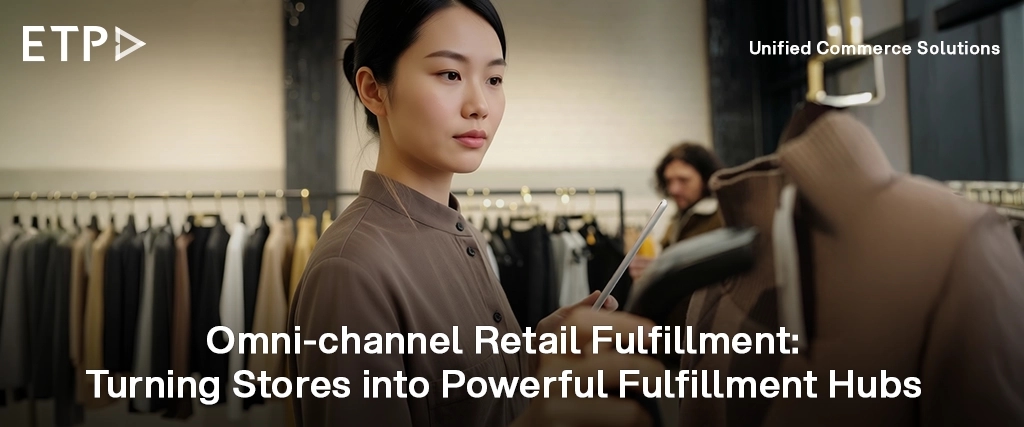
Retail fulfillment is undergoing a structural shift. Stores are no longer just places where transactions happen. They are becoming strategic fulfillment nodes that help retailers deliver faster, reduce logistics costs, and unlock new revenue opportunities.
Omni-channel fulfillment allows retailers to route orders dynamically across stores, warehouses, and distribution centers. When supported by unified inventory management and intelligent order management, stores can function as high-speed fulfillment hubs capable of handling click-and-collect, ship-from-store, and endless aisle scenarios.
For retailers across India, Southeast Asia, and APAC, where delivery speed and operational efficiency increasingly influence purchasing decisions, turning stores into fulfillment hubs is quickly becoming a competitive necessity.
Why Retailers Are Rethinking Omni-Channel Retail Fulfillment
The growth of digital commerce has fundamentally changed customer expectations. Customers now expect:
- Same-day or next-day delivery
- Real-time inventory visibility
- Flexible pickup options
- Seamless experiences across online and physical stores
At the same time, logistics costs are rising. Shipping every order from centralized warehouses is no longer sustainable, especially in dense urban markets.
This is where omni-channel retail fulfillment changes the game.
By transforming stores into distributed fulfillment nodes, retailers can:
- Reduce last-mile delivery costs
- Speed up order delivery
- Improve inventory utilization
- Increase store productivity
Retailers that rely on disconnected commerce systems often struggle with inaccurate inventory and delayed fulfillment. Unified commerce platforms solve this by creating a single source of truth across all retail channels.
What Is Omni-Channel Retail Fulfillment?
Omni-channel fulfillment refers to the ability to manage and fulfill orders seamlessly across multiple retail channels using shared inventory and coordinated logistics.
It typically includes capabilities such as:
- Ship-from-store
- Click-and-collect / BOPIS
- Endless aisle ordering
- Cross-store fulfillment
- Warehouse and store inventory synchronization
The key enabler behind this capability is a modern order management system for retail supported by unified inventory management. Without real-time inventory visibility, stores cannot reliably act as fulfillment centers.
The Rise of Store-Based Fulfillment
Physical retail stores represent a massive untapped logistics network. Last-mile delivery accounts for up to 53% of total shipping costs. (Source: Capgemini)
This shift is especially important in APAC retail markets, where:
- Urban density favors distributed fulfillment
- Delivery expectations are extremely high
- Logistics costs continue to rise
Retailers that activate their store networks as fulfillment hubs unlock a powerful operational advantage.
The Technology Behind Omni-Channel e-Commerce Fulfillment
To turn stores into fulfillment hubs, retailers need several core capabilities working together.
1. Unified Inventory Management
Inventory must be visible across:
- Stores
- Warehouses
- Distribution centers
- Online channels
Unified inventory management ensures that all channels access the same real-time stock data. This prevents overselling and allows retailers to allocate orders dynamically.
2. Intelligent Order Management
An intelligent order management system determines where an order should be fulfilled. The system evaluates factors such as:
- Proximity to customer
- Inventory availability
- Shipping cost
- Store capacity
- Delivery timelines
Advanced intelligent order management software automatically routes orders to the most efficient fulfillment location.
3. Omni-Channel Logistics
Retail fulfillment is no longer linear. Orders may move through multiple paths:
- Warehouse → customer
- Store → customer
- Store → store → customer
Effective omni-channel logistics ensures these flows are coordinated efficiently.
How Store Fulfillment Works in Practice
When retailers adopt omni-channel e-Commerce fulfillment, stores can support several high-impact use cases.
Ship-From-Store
Online orders are fulfilled from nearby stores instead of warehouses.
Benefits:
- Faster delivery
- Lower shipping costs
- Reduced warehouse pressure
Click and Collect
Customers order online and pick up from stores.
Benefits:
- Higher store traffic
- Lower fulfillment costs
- Additional in-store purchases
Endless Aisle
If an item is out of stock in one store, staff can order it from another store or warehouse for home delivery.
Benefits:
- Prevents lost sales
- Improves customer experience
What Retailers Need to Enable Store Fulfillment
Retailers planning to implement omni-channel fulfillment should ensure they have the following capabilities:
- Real-time inventory management for multiple locations
- Intelligent order routing and orchestration
- Seamless integration between e-Commerce and stores
- Store-level picking and packing workflows
- Real-time logistics visibility
- A unified commerce platform connecting all channels
Without these foundations, store-based fulfillment becomes operationally difficult.
Why Unified Commerce Is the Real Enabler
Many retailers attempt to implement omni-channel fulfillment using disconnected systems. Typical architecture may include separate systems for:
- e-Commerce
- Store POS
- Warehouse management
- Order management
This fragmentation creates data delays and operational friction.
A unified commerce platform connects these capabilities into a single ecosystem where:
- Inventory updates in real time
- Orders are orchestrated centrally
- Stores and warehouses operate on shared data
This unified approach allows retailers to scale omni-channel retail fulfillment without complexity.
How ETP Unify Enables Store-Based Fulfillment
Modern retailers need technology that connects stores, warehouses, and digital channels into one coordinated fulfillment network.
ETP Unify Omni-channel Fulfilment helps retailers enable distributed fulfillment by providing:
- Real-time unified inventory management
- Advanced intelligent order management
- Seamless integration across stores and e-Commerce
- Dynamic order routing for faster deliveries
- Scalable omni-channel e-Commerce fulfillment
Retailers can transform their physical stores into high-performance fulfillment hubs while maintaining complete operational visibility.
Strategic Benefits for Retailers
Retailers implementing omni-channel fulfillment typically see improvements across several areas:
- Faster Delivery - Orders can be fulfilled from the nearest location.
- Better Inventory Utilization - Store inventory becomes digitally available for online orders.
- Lower Logistics Costs - Shorter delivery routes reduce shipping expenses.
- Higher Store Productivity - Stores become operational assets rather than cost centers.
In an increasingly competitive retail landscape, these benefits translate directly into stronger margins and better customer experiences.
The Future of Retail Fulfillment
Retail fulfillment is moving toward distributed commerce networks. Instead of relying on centralized warehouses alone, retailers are building fulfillment ecosystems where:
- Stores
- Warehouses
- Dark stores
- Micro-fulfillment centers
all work together.
Retailers that invest in omni-channel retail fulfillment today will be better positioned to deliver the speed, flexibility, and convenience that modern customers expect.
Final Takeaway
Physical stores are no longer just sales channels. They are strategic assets that can power faster delivery, improve inventory utilization, and reduce fulfillment costs.
With the right technology foundation including unified inventory management, intelligent order management, and unified commerce, retailers can transform their store networks into powerful fulfillment engines.
Ready to Turn Your Stores into Fulfillment Hubs?
Explore how ETP Unify enables scalable omni-channel fulfillment across stores, warehouses, and e-Commerce channels.
Book a demo with ETP experts and see how unified commerce can transform your retail operations.
Common Questions About Omni-channel Retail Fulfillment
What is omni-channel retail fulfillment?
Omni-channel retail fulfillment enables retailers to manage and fulfill orders across stores, warehouses, distribution centers, and multiple retail channels using shared inventory and coordinated order management.
How do stores become fulfillment hubs?
Stores become fulfillment hubs when retailers connect store inventory, order management, and logistics systems. This enables ship-from-store, click-and-collect, and endless aisle fulfillment.
What technology is needed for omni-channel retail fulfillment?
Retailers need unified inventory management, intelligent order management, seamless system integration, store-level fulfillment workflows, and real-time logistics visibility to support efficient omni-channel fulfillment.