Picking a point of sale system is one of the most strategic decisions a retailer makes. It touches everything from checkout speed to inventory accuracy to customer experience. But with digital transformation reshaping how retail works, the old, server-based POS systems are starting to feel like legacy tools for a modern world.
That’s where Cloud POS comes in.
Here’s the thing: cloud-based retail systems aren’t just a tech upgrade. They change how you see data, how staff work in stores, and how customers interact with your brand. This guide breaks down what makes cloud POS different from traditional POS, why retailers are making the switch, and how to choose the right one—especially as customer expectations keep rising.
What is Cloud POS and Why it Matters
At its core, a Cloud POS is a point of sale system that runs on the internet rather than on local servers in your store. Instead of storing data on a box in the back office, everything lives in the cloud—secure servers managed by a provider.
This shift has big implications:
- You can access your system from anywhere
- Updates happen automatically
- Data syncs in real time across stores and channels
- Your team can be more flexible and productive
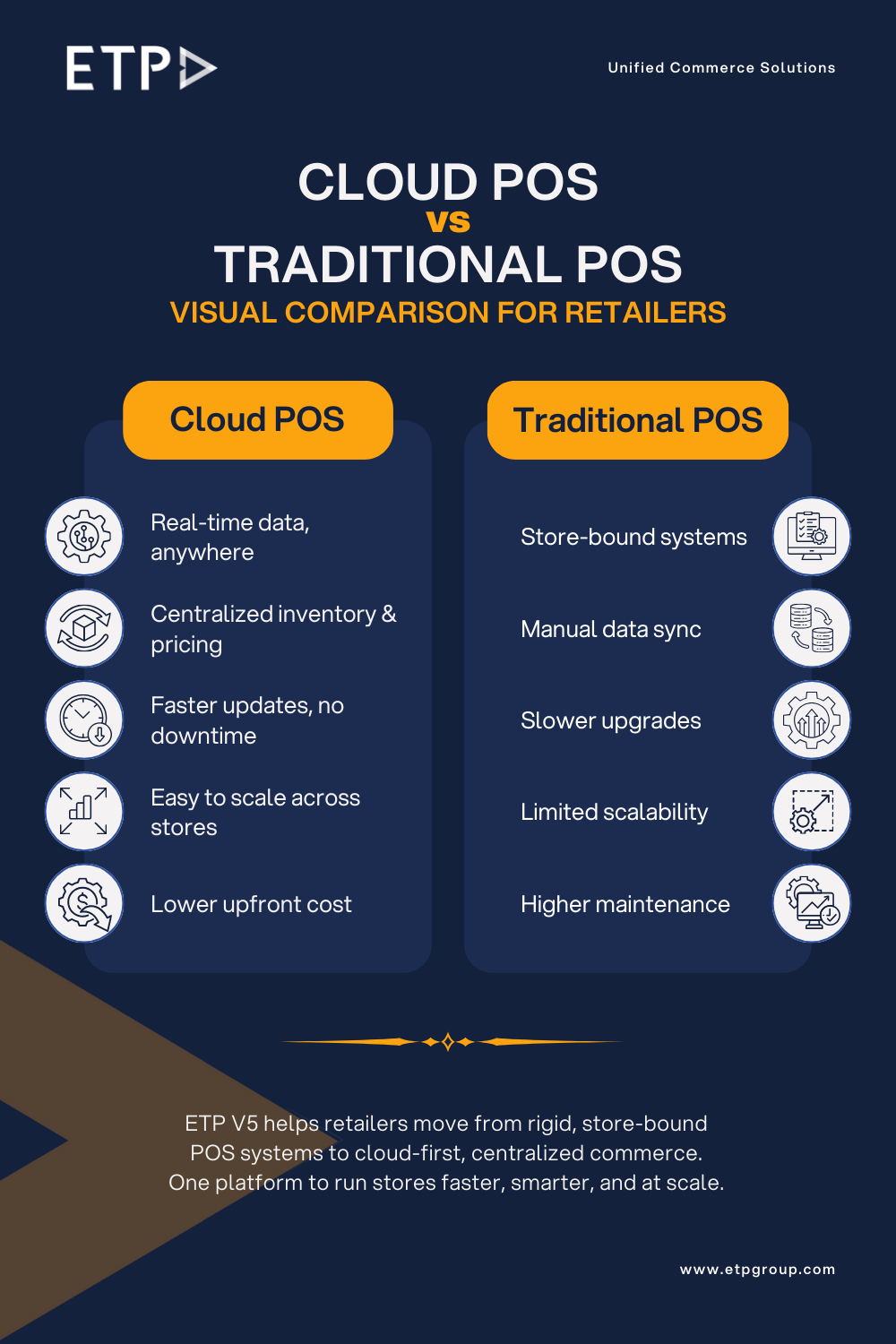
In contrast, traditional POS systems store all data on local hardware. That worked when retail was simpler. But today, when customers expect real-time inventory, click-and-collect, and loyalty across channels, store-bound systems struggle to keep up.
The right cloud native retail solution will feel like a platform, not just a checkout tool.
Cloud Native POS System and Customer Experience
At the end of the day, technology serves people—both employees and customers.
Flexibility and Accessibility
Cloud native POS software gives you access from anywhere with an internet connection. Store managers can check sales performance on their phones. Inventory data updates instantly across locations. You aren’t tied to specific hardware or on-site servers.
Traditional POS locks your data and functionality to one place. If the server goes down, your POS often goes down too.
This matters when you’re scaling, managing multiple outlets, or need remote visibility.
Updates and Innovation
Cloud POS updates are automatic. New features roll out globally without installing patches store by store.
Traditional POS tends to require manual upgrades—often at additional cost and downtime.
With cloud-native systems, innovation becomes part of your rhythm, not an occasional disruption.
Cost and Maintenance
Upfront costs for cloud native POS systems are usually lower. You don’t buy servers or pay for heavy on-site maintenance. Subscription pricing means predictable operating costs.
Traditional POS can be capital-intensive. Servers, backups, network hardware, and IT staff add to the bill.
Security and Compliance
Cloud providers invest heavily in security, backups, and compliance. Your data lives in professionally managed environments monitored 24/7.
Traditional systems can be secure, but they require retailers to own and manage that responsibility.
Cloud Native Retail Solution: Beyond the Checkout
A cloud native retail solution does more than support transactions. It becomes a central hub that connects the front end with inventory, loyalty, analytics, and customer data. When your POS lives in the cloud, it becomes a data engine.
Here’s how that plays out:
- Inventory accuracy: Real-time stock visibility across stores and channels
- Customer engagement: Loyalty and purchase history tie directly to checkout
- Analytics: Sales trends and performance dashboards accessible from anywhere
- Omni-channel fulfillment: Sell online, fulfill from store without data silos
Traditional POS systems usually operate in their own bubble. Unless they’re heavily customized, they don’t talk seamlessly with the rest of your tech stack.
Cloud native point of sale solutions act like a central nervous system for your business.
The Operational Advantages of Cloud POS
When you replace a traditional system with a Cloud POS, you see impact across teams and operations.
For Store Managers
Store managers gain control. They see real-time dashboards. They can troubleshoot issues without waiting for IT. They aren’t wrestling with servers in the back office.
For Staff
Cloud POS systems often run on tablets, mobile devices, or flexible hardware. Staff can checkout customers anywhere on the floor. That drives better experiences and shorter lines.
For IT Teams
Your IT team can shift focus from maintenance to strategy. No patching servers store by store. No juggling backups and network licenses. Updates happen centrally.
For Headquarters
Executives and HQ teams can see performance across the business—not just daily totals, but trends, exceptions, and opportunity areas.
That level of visibility changes decision making. It moves from reactive to proactive.
Scalability and Growth: Why Cloud POS Wins
Scaling a retail business with a traditional POS often feels like building a house room by room. Every new store means more hardware, more setup, more configuration, and more potential points of failure.
With cloud native POS software, scalability becomes seamless. Adding a new location is about connecting hardware and logging in. Because the data and system logic live in the cloud, new stores tap into the same platform instantly.
This also applies to peak seasons. Cloud systems flex with demand, while traditional servers can choke under spikes unless they’re over-spec’d and costly to maintain.
Whether you’re opening your second store or your fiftieth, a cloud native point of sale system positions you to grow without wrestling with the backend every step of the way.
Choosing the Right Cloud POS: What Retailers Should Look For
All cloud POS systems aren’t the same. When you’re evaluating options, here are critical factors to consider:
- Inventory visibility and sync
Real-time updates across channels and stores. - Ease of use
Intuitive interface that your team can adopt fast. - Integration ecosystem
Needs to connect with e-Commerce, loyalty, payments, and OMS. - Offline capability
Stores should function even if the internet hiccups. - Security and compliance
PCI compliance and secure data storage shouldn’t be optional. - Configurability
Business rules, pricing models, and promotions need flexibility without heavy development.
The right cloud native retail solution will feel like a platform, not just a checkout tool.
Cloud Native POS System and Customer Experience
- At the end of the day, technology serves people—both employees and customers.
- A cloud native POS system improves customer experience in these ways:
- Faster checkout with mobile or queue-busting options
- Unified customer profiles tied to loyalty and purchase history
- Accurate inventory availability at checkout
- Ability to offer flexible fulfillment like buy online pickup in store
- Personalized promotions at the point of sale
Customers see speed, accuracy, and relevance. Staff see tools that help them deliver those outcomes.
That’s the practical payoff of moving to cloud POS.
ETP Unify Cloud POS: A Future-Ready Point of Sale for Modern Retail
When you look at cloud POS solutions in the market, one that stands out for retailers aiming for unified commerce is ETP Unify Cloud POS.
ETP Unify’s cloud native point of sale is built to support the way modern retailers actually operate—connected, omni-channel, and customer-centric. Because it’s part of the broader ETP Unify platform, it doesn’t live in isolation. Inventory, orders, customer data, and store operations all sync in real time.
This cloud native pos system allows:
- Centralized management with consistent experiences across stores
- Offline capability so stores never lose momentum
- Support for diverse retail formats from apparel to grocery and more
- Seamless integration with intelligent order management, loyalty, and e-Commerce
What this really means is a single, cloud-native retail solution that lets teams focus on customers, not servers; on experiences, not reconciliations; and on growth, not maintenance.
For retailers ready to step into a more connected, agile, and scalable future, ETP Unify Cloud POS isn’t just a tool, it’s the foundation for next-generation retail operations.
Want to deliver a seamless unified experience? Let’s talk: Book a demo
- วิธีรวมร้านค้าออนไลน์และร้านค้าจริงของคุณเป็นประสบการณ์ลูกค้าที่กลมกลืนเป็นหนึ่งเดียว (โดยไม่ต้องเสียเวลาหลายเดือนไปกับการบูรณาการที่ยุ่งยาก)
- ใช้ข้อมูลเชิงลึกจาก AI เพื่อจัดการสต็อก ลดการสูญเสีย และเพิ่มยอดขายให้สูงสุดในทุกช่องทาง
- ตัวอย่างจากโลกจริงที่แสดงให้เห็นว่าแพลตฟอร์มของ ETP กำลังช่วยเพิ่มประสิทธิภาพที่วัดได้และเพิ่มรายได้อย่างมีนัยสำคัญให้กับผู้ค้าปลีกชั้นนำ