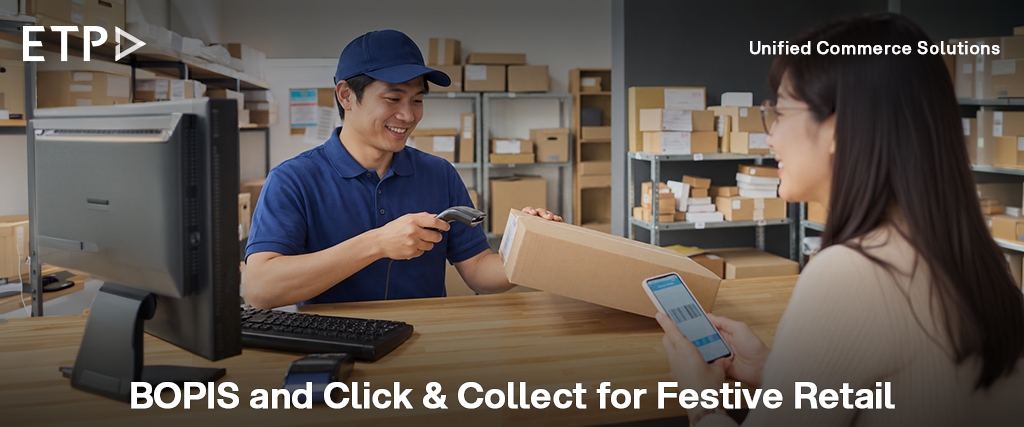
A customer places an order online, chooses a nearby store for pickup and arrives later that day to collect it.
That transaction may look complete. For the retailer, it can be the start of another opportunity.
BOPIS, or Buy Online, Pick Up In-Store, connects an online purchase with a physical store visit. During the festive season, that connection can matter even more. A customer who comes into a store to collect an order may browse other products, discover an offer or make an additional purchase.
But that opportunity depends on the basics working first.
The right product needs to be available at the right store. The order needs to reach the store correctly. The customer needs accurate pickup information. Store teams need visibility into what has been ordered and what needs to be handed over.
That makes BOPIS less about adding a pickup option and more about connecting the online order with the store operation behind it.
The festive Buy Offline Pickup inStore opportunity starts before the customer reaches the store
During peak shopping periods, customers are often balancing urgency and convenience.
They may want a product quickly but not want to wait for home delivery. They may be shopping for a gift and want to collect it on the way home. Or they may simply prefer knowing that the product is available at a nearby store before making the trip.
Click and collect addresses that need by allowing customers to purchase online and collect from a physical location.
For retailers, though, the customer-facing option creates several operational questions:
- Is the product actually available at the selected store?
- Is that inventory already committed to another order?
- Which location should fulfil the order?
- Can the store prepare the order in time?
- How does the customer know when it is ready?
- What happens if the item becomes unavailable?
During festive peaks, these questions become harder to manage because order volumes, inventory movement and store activity all increase at the same time.
A BOPIS order is an inventory decision too
The customer sees a simple choice: pick up from store.
Behind that choice is an inventory decision.
Suppose a retailer has the same festive SKU across several stores and fulfilment locations. A customer selects Store A because it is closest to them. The system therefore needs to know whether the stock shown at Store A is genuinely available for that order.
This is where real-time inventory visibility becomes important.
A BOPIS experience depends on inventory information being reliable enough to support the promise being made to the customer. If an online channel shows an item as available for pickup but the store cannot locate it, the convenience of BOPIS quickly turns into customer frustration.
Unified inventory management can help retailers maintain a clearer view of available stock across locations and customer-facing channels.
That matters particularly during festive demand, when the same inventory may be moving between online orders, store sales, transfers, reservations and other fulfilment requirements.
The pickup location can influence the fulfilment decision
Not every online order needs to follow the same fulfilment path.
For a BOPIS order, the selected store may be the natural fulfilment location. But retailers may also need rules around inventory availability, location, order priority and fulfilment capacity.
This is where smart order management becomes relevant.
Instead of treating every order as a standalone transaction, retailers can use order management and orchestration to determine how orders should move through the operation.
For example, a retailer may need to:
- Identify the customer's selected pickup location.
- Check inventory availability.
- Allocate the order to the appropriate fulfilment location.
- Prepare the order for collection.
- Update its status so the customer and store team know what is happening.
The important point is that the customer should not have to understand any of this.
The complexity belongs in the retail operation, not in the customer experience.
The store visit is where BOPIS gets interesting
Once the customer arrives to collect the order, the retailer has a physical interaction that would not have happened with a conventional home delivery.
That creates a potential opportunity to increase the value of the visit.
A customer picking up a pair of festive shoes might notice accessories near the pickup area. Someone collecting a gift order might browse another category while waiting. A customer who originally bought online may discover a product they had not considered when browsing the website.
These are possibilities, not guaranteed outcomes.
The important distinction is that BOPIS creates a reason for an online customer to enter a physical store.
Retailers can then think about what that store experience should look like.
That could include relevant merchandising around pickup areas, clear navigation, appropriate promotions or recommendations from store associates. The objective is not to make the pickup process slower. It is to make the additional store interaction useful when the customer is open to it.
What can go wrong during festive BOPIS?
BOPIS sounds straightforward until demand increases.
A few operational gaps can quickly affect the experience.
Inventory says available. The store says otherwise.
If inventory is not updated accurately, customers may select a pickup location based on stock that is no longer available.
The order reaches the wrong operational queue.
If order routing and fulfilment rules are unclear, store teams may have difficulty prioritising pickup orders alongside regular store activity.
The customer arrives before the order is ready.
A pickup promise creates an expectation. If the customer arrives and the store is still searching for the product, the convenience of BOPIS disappears.
Store teams lack order visibility.
The store needs enough information to locate, prepare and hand over the order without relying on manual reconciliation across different systems.
Online and store promotions don't connect.
Festive shoppers often move between channels. If pricing, promotions or customer information are fragmented, the retailer may miss opportunities to make that journey feel connected.
These are not exclusively BOPIS problems. They are symptoms of disconnected retail operations.
BOPIS works better when the channels work together
The technology behind click and collect does not need to be visible to the customer.
What matters is that the online storefront, inventory, order management, fulfilment and store operations can support the same customer journey.
A connected operating model can help retailers coordinate:
Online order → inventory check → order allocation → store fulfilment → pickup readiness → store handover
That connection becomes particularly useful during festive peaks, when there is less room for manual intervention.
It also gives retailers more flexibility in how they use their physical stores.
A store can remain a sales environment while also supporting fulfilment and pickup. Depending on the operating model, ship-from-store and other omnichannel fulfilment approaches can also help retailers make better use of inventory closer to customers.
The goal is not to turn every store into a warehouse.
It is to make the store part of the fulfilment network when that makes operational sense.
How retailers can make BOPIS work better during the festive season
A strong festive BOPIS strategy does not begin with the pickup counter. It starts with the operational foundation behind it.
1. Make pickup availability trustworthy
Customers should be able to make a pickup decision based on reliable inventory information.
2. Define how pickup orders are allocated
Set clear rules around which location should fulfil an order and what happens when the preferred location cannot fulfil it.
3. Give stores visibility into incoming orders
Store teams need to know what has been ordered, what needs to be prepared and which customers are expected for collection.
4. Keep the pickup journey simple
The customer should know where to go, when the order is ready and what they need to collect it.
5. Think beyond the handover
Once the customer is in the store, the experience can continue. Relevant merchandising, promotions and assisted selling can create opportunities without turning pickup into a sales obstacle.
6. Measure the operational side
Retailers should look beyond the number of BOPIS orders. Pickup readiness, order accuracy, inventory discrepancies, cancellations and customer wait times can reveal where the process needs attention.
Where unified commerce fits
BOPIS is a good example of why retail channels cannot always be managed independently.
The customer may see one order. Behind it are multiple operational touchpoints: the e-commerce channel, inventory, order management, fulfilment and the physical store.
ETP's unified commerce approach brings these connected retail operations into the same broader framework. Relevant capabilities include Click & Collect, Unified Inventory Management, Smart Order Management, Omnichannel Fulfilment and Ship-from-Store.
For festive retail, that connection can help retailers think about BOPIS as more than a delivery alternative. It becomes part of how online demand, store inventory and physical customer interactions work together.
Explore ETP's Unified Commerce solution to see how these capabilities fit into a connected retail operating model. Let’s connect!
Common Questions Retail Leaders Ask
What is BOPIS in retail?
BOPIS stands for Buy Online, Pick Up In-Store. It allows customers to place an order through an online channel and collect it from a physical store instead of having it delivered to their home.
What is the difference between BOPIS and click and collect?
The terms are often used interchangeably. Both describe a retail model where customers purchase online and collect their orders from a physical store or designated pickup location.
Why is BOPIS useful during the festive season?
BOPIS gives customers another fulfilment option when they want convenience and access to products without waiting for home delivery. For retailers, it also connects an online order with a physical store visit.
Does BOPIS require real-time inventory visibility?
Reliable inventory visibility is important because customers need accurate information about whether an item can be picked up from a particular location. The retailer also needs to know which inventory can be allocated to the order.
How can retailers use stores for BOPIS fulfilment?
Stores can act as pickup locations and, depending on the retailer's operating model, may also support fulfilment activities such as preparing online orders or shipping products to customers.
Can BOPIS help increase basket value?
BOPIS creates an additional physical interaction with a customer who originally purchased online. That creates an opportunity for relevant product discovery, promotions or assisted selling, although any increase in basket value depends on the retailer's store experience and merchandising approach.
- วิธีรวมร้านค้าออนไลน์และร้านค้าจริงของคุณเป็นประสบการณ์ลูกค้าที่กลมกลืนเป็นหนึ่งเดียว (โดยไม่ต้องเสียเวลาหลายเดือนไปกับการบูรณาการที่ยุ่งยาก)
- ใช้ข้อมูลเชิงลึกจาก AI เพื่อจัดการสต็อก ลดการสูญเสีย และเพิ่มยอดขายให้สูงสุดในทุกช่องทาง
- ตัวอย่างจากโลกจริงที่แสดงให้เห็นว่าแพลตฟอร์มของ ETP กำลังช่วยเพิ่มประสิทธิภาพที่วัดได้และเพิ่มรายได้อย่างมีนัยสำคัญให้กับผู้ค้าปลีกชั้นนำ