The modern retailer no longer serves a single storefront. Today's consumer researches on a smartphone, compares prices on a marketplace, purchases via a point of sale terminal in-store and expects a return through any channel, all as one seamless experience. This is not a niche behaviour. It is the new baseline of retail commerce, and it is accelerating.
Traditional POS system software was engineered for a simpler world: one till, one store, one transaction at a time. These systems were never designed to orchestrate the layered complexity of simultaneous digital and physical commerce. That structural gap between what legacy retail point of sale infrastructure can deliver and what modern retail demands is precisely where retailers are haemorrhaging revenue, losing customers and falling behind more technology-forward competitors.
The solution requires a foundational rethink of how retail technology is architected. At the centre of that rethink is the omni-channel point of sale system, the strategic intelligence layer that connects every channel, every store and every customer into a single, coherent retail operation.
ETP Insight: The cost of inaction is measurable - lost sales from stockouts, customer churn from poor cross-channel experiences and significant management overhead from reconciling fragmented data across disconnected systems.
Source: Harvard Business Review / Aberdeen Group
In this guide, ETP Group, one of the region's leading omni-channel retail POS provider, examines what omni-channel POS is, how it works, why it matters, and how to choose the right POS solution for your retail business in 2026.
Key Takeaways
- An omnichannel point of sale system unifies in-store, online, and mobile commerce into one connected retail operation
- The right omnichannel POS software eliminates inventory silos, enables real-time fulfilment, and centralises customer data
- Enterprise retailers need a retail POS system built for multi-location scale, ERP integration, and AI-driven intelligence
- ETP V5 is ETP Group's dedicated omni-channel POS, which is purpose-built for complex, multi-store retail environments across India, Southeast Asia.
What Is an Omni-channel Point of Sale System?
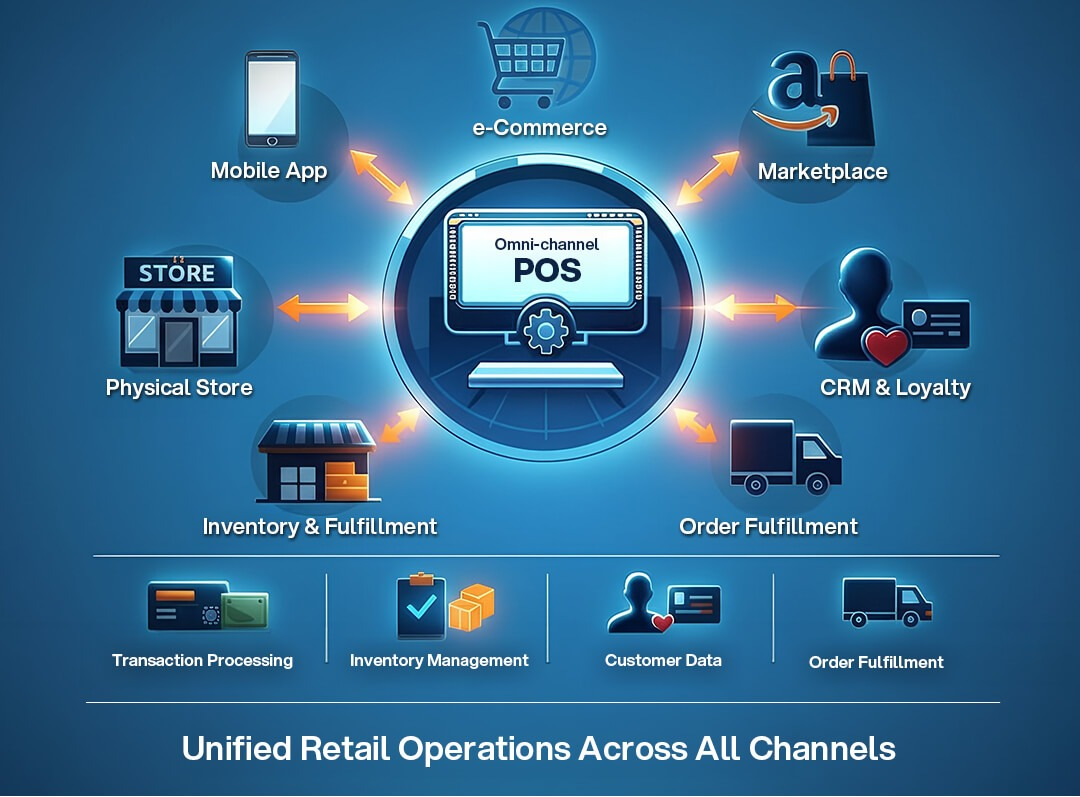
An omni-channel point of sale system is a retail technology platform that unifies transaction processing, inventory management, customer data and order fulfilment across every physical and digital channel, in a single, connected architecture. It is the technology backbone that makes omni-channel retail operationally POSsible at enterprise scale.
A retail POS system at the omni-channel level goes far beyond simple transaction processing. It eliminates the silos that exist between in-store, e-Commerce, mobile commerce and marketplace channels, ensuring that a sale in one channel is visible across all others instantaneously.
How Does Omni-channel POS Differ from Traditional and Multi-channel POS?
A traditional point of sale software system operates as a standalone register for a single store, with no real-time connection to other channels. A multi-channel POS system manages multiple channels in parallel but separately, creating data inconsistencies and operational fragmentation.
An omni-channel POS solution eliminates these silos entirely. It creates one unified system where every channel operates from the same inventory pool, the same customer record, and the same real-time data.
Traditional vs Multi-channel vs Omni-channel POS
Within the broader retail technology architecture, omni-channel POS software sits at the intersection of ERP, CRM, warehouse management (WMS) and e-Commerce platforms, functioning simultaneously as a POS system software transaction engine and an orchestration layer for unified commerce.
Why Retailers Need Omni-channel POS Today
The business case for investing in a robust omni-channel POS for retail is no longer aspirational. It is an operational imperative driven by measurable commercial risk. Here is why retailers across every segment are making the transition now:
Eliminating Channel Silos
When inventory, pricing, promotions, and customer data live in separate systems per channel, inconsistencies multiply. Customers receive conflicting information; staff cannot serve shoppers effectively. Omni-channel POS software unifies all of this into a single, authoritative source of truth.
Real-Time Inventory Visibility
In an era of instant fulfilment expectations, overselling or inaccurate stock counts cause direct revenue loss. A retail point of sale system with real-time inventory and point of sale sync eliminates this across every store, warehouse, and virtual shelf.
Flexible Fulfilment at Scale
Buy online pick up in-store (BOPIS), ship-from-store, endless aisle, and same-day delivery are now customer expectations. The right POS software for retail provides the infrastructure to deliver these profitably.
Unified Customer Data for Loyalty
Without a centralised customer profile linking online and offline behaviour, personalisation is impossible. Effective omni-channel loyalty management, the primary driver of retention, depends on this unified foundation.
Multi-Location & Multi-Store Complexity
As retailers scale across new stores and markets, the inability to manage operations from a unified multi store retail management software platform becomes a strategic liability. Omni-channel retail POS is architecturally designed to scale with the business.
Cross-Channel Inventory Accuracy
Fragmented POS systems for retail store environments produce chronic inventory inaccuracies. Retail POS and inventory management software built on omni-channel principles resolves this at the root.
ETP Insight: The cost of inaction is measurable - lost sales from stockouts, customer churn from poor cross-channel experiences and significant management overhead from reconciling fragmented data across disconnected systems.
How Omni-channel POS Works: End-to-End Process Flow
A modern omni-channel point of sale system connects every step of the retail transaction lifecycle, from initial order capture through to POSt-purchase reporting, in a continuous, automated, and genuinely real-time flow. This is what separates enterprise omni-channel POS software from legacy retail POS solutions.
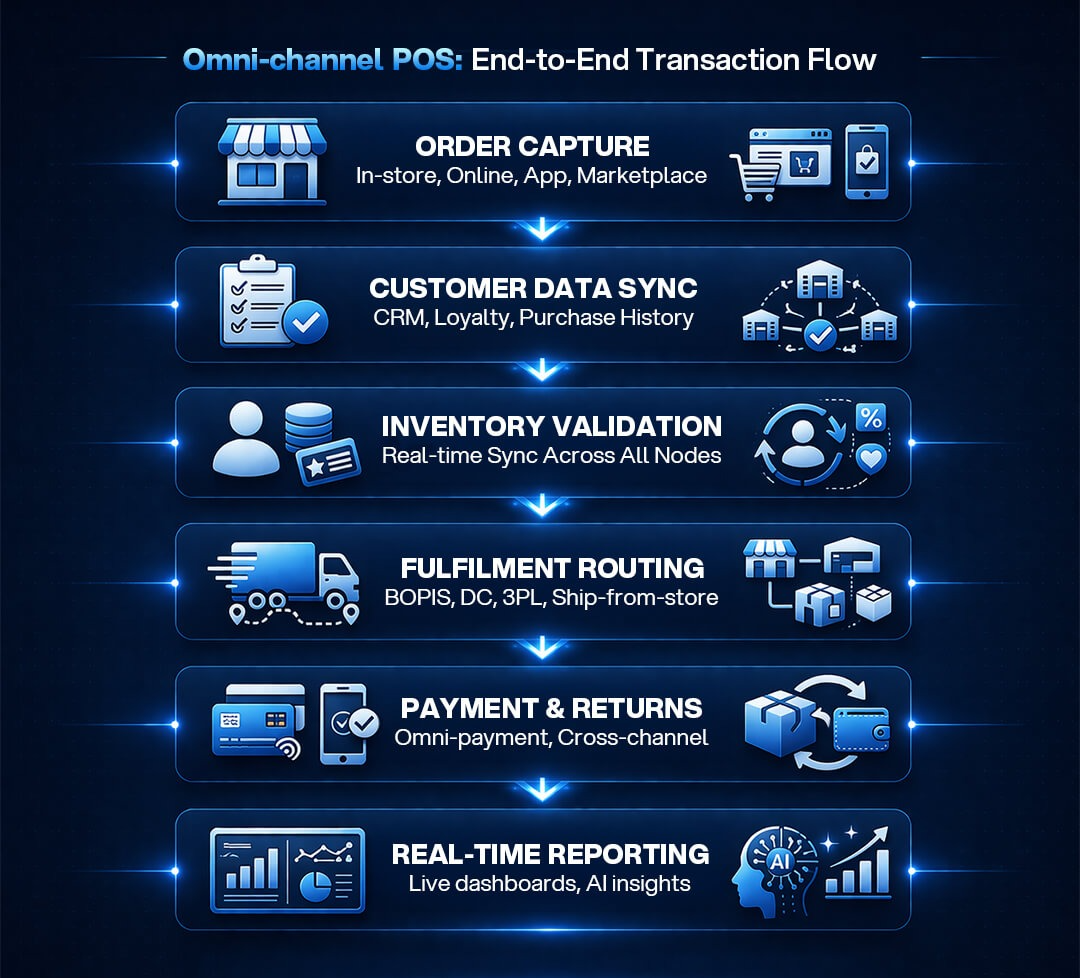
What makes this flow genuinely powerful is that every step is bi-directional and real-time. A return processed in-store updates inventory counts visible to the e-Commerce platform instantly. A loyalty balance earned online is redeemable at the till in the same moment. A stock replenishment decision triggered by AI propagates across every channel simultaneously. This closed-loop architecture is what distinguishes a true omni-channel POS system from a collection of connected POS software solutions.
Key Features of an Omni-channel POS System
Not all retail POS software platforms are created equal. An enterprise-grade omni-channel POS solution must deliver the following core capabilities to qualify as genuinely omni-channel:
1. Centralised Management Dashboard
A single command centre providing real-time visibility across all stores, channels, and geographies. This is the foundation of effective multi store point of sale management, enabling leaders to act on live intelligence rather than yesterday's batch reports.
2. Real-Time Inventory Synchronisation
Automated, continuous inventory point of sale sync across physical stores, distribution centres, e-Commerce platforms, and marketplaces. The best inventory and point of sale software eliminates overselling, reduces safety stock waste, and enables confident fulfilment decisions. It is the operational enabler of effective multi channel retail operations.
3. Unified Customer Profiles
Every customer interaction, whether online, in-store, via app, or through a marketplace, is captured and consolidated into a single customer record. This unified profile powers personalised engagement, loyalty programme management and AI-driven product recommendations at every touchpoint.
4. Multi-Channel Order Capture
The ability to process transactions across every touchpoint: physical retail store point of sale system terminals, mobile POS (mPOS), e-Commerce checkout, self-service kiosks, and phone orders, all flowing into a single order management backbone. This is omni-channel POS for retail in operational practice.
5. Intelligent Fulfilment Logic
AI-powered routing determines the most efficient fulfilment node for every order - ship-from-store, click-and-collect, DC dispatch, or a hybrid. This is where online retail POS software and physical commerce truly converge, optimising both cost and delivery speed dynamically.
6. Integrated Omni-Payment Processing
Unified payments across all channels - card, digital wallets, BNPL, cash, gift cards, and loyalty points - with a single reconciliation process and real-time fraud detection. Any credible online POS system must include robust, integrated payment capabilities as a core feature, not a bolt-on.
7. Cross-Channel Returns Management
A customer who purchased online should be able to return in-store without friction. Omni-channel retail solutions make this possible by linking order history, payment records, and inventory updates across every channel in real time, a non-negotiable feature for modern retail point of sale software.
8. Advanced Analytics and AI-Powered Reporting
Real-time dashboards, predictive analytics and AI-generated insights covering sales performance, inventory point of sale software health, customer behaviour and operational efficiency. The best retail POS system embeds this intelligence natively rather than treating reporting as an afterthought.
9. Promotion Planning and Pricing Management
Enterprise promotion planning solutions integrated within the POS platform ensure that pricing rules, promotional offers, and discount hierarchies are applied consistently across every channel and location, eliminating the revenue leakage caused by promotional inconsistency.
Key Business Benefits of Omni-channel POS
The tangible business impact of implementing a robust omni-channel POS system extends across every function of the retail organisation. These are the benefits that drive the investment decision:
Increased Sales Visibility
Complete, real-time commercial intelligence across all channels enables faster and more confident decisions, from promotional planning to markdown management, across every POS system for retail stores in the network.
Improved Inventory Accuracy
Retailers deploying integrated retail POS software with inventory consistently report dramatic reductions in stockout events and inventory discrepancies, directly improving sell-through rates and working capital efficiency.
Accelerated Order Fulfilment
Intelligent routing and real-time inventory point of sale system data reduce order processing times, improving customer satisfaction scores and reducing last-mile delivery costs.
Stronger Customer Retention
Personalised, consistent experiences, enabled by unified customer profiles and cross-channel loyalty, drive repeat purchase rates and lifetime value measurably upward.
Scalable Multi-Location Growth
A cloud-native retail POS system enables rapid store rollouts and market entries without proportional increases in operational overhead. This is the defining advantage of multi store retail POS software.
Margin Improvement
Reduced shrinkage, lower safety stock requirements, better promotional execution, and fewer manual processes all contribute directly to improved gross and net margins, measurable from the first quarter of deployment.
Operational Challenges Without Omni-channel POS
For retailers still relying on disconnected POS system software or legacy retail point of sale infrastructure, the day-to-day operational reality is increasingly costly, and the competitive gap widens every quarter:
Disconnected Systems
When the in-store point of sale software for retail stores, e-Commerce platform and ERP each hold different versions of the same data, every decision is made on incomplete information.
Manual Reconciliation Overhead
Teams spend hours daily reconciling POS retail store data across systems; time directly stolen from customer experience and commercial strategy.
Chronic Stock Mismatches
Without real-time inventory and point of sale system integration, retailers either overstock to hedge against uncertainty or suffer the stockouts that drive customers to competitors.
Delayed Reporting and Blind Spots
Batch reporting cycles mean leadership is always making strategic decisions based on stale data. In fast-moving retail, this is a structural liability.
Inconsistent Customer Experiences
Pricing, promotions and loyalty redemption varying by channel destroys brand trust and makes retention nearly impossible to sustain at scale.
Inability to Scale
A POS system for retail business that cannot be centrally managed across dozens or hundreds of locations becomes a growth constraint rather than a growth enabler.
These challenges compound exponentially at scale. What is manageable friction with five stores becomes an operational crisis at fifty and a strategic catastrophe at five hundred.
Omni-channel POS for Enterprise & Multi-Location Retail
Enterprise retailers face a category of complexity that SMB-focused POS software for retail store solutions are architecturally incapable of handling. POS systems for large retail organisations, and the multi-store point of sale software that serves them, must address a fundamentally different set of requirements:
Complex Store Networks
Managing hundreds of POS system store locations, each with unique trading patterns, staff configurations and local compliance requirements, demands centralised governance with localised flexibility.
Franchise Model Support
Franchise retail requires fine-grained permission controls, consolidated reporting and the ability to enforce brand standards while accommodating franchisee-level customisation. This is not achievable with generic/traditional POS software tools.
Cross-Border Operations
Multi-currency, multi-language and multi-tax-regime support is non-negotiable for retailers operating across multiple geographies. Enterprise-grade online POS software must handle this natively.
High-SKU Retail Environments
Fashion, grocery and electronics retailers managing tens of thousands of active SKUs require a retail POS and inventory management software engine that performs at speed and scale without degradation.
Governance, Compliance & Audit
Role-based access, audit trails, and centralised policy management, including supermarket billing software and billing software for retail store compliance requirements, are the enterprise governance features that separate true multi-store retail management software from consumer-grade tools.
Scanner & Hardware Integration
Enterprise deployments require a retail POS system with scanner capability, integrated barcode readers, label printers and payment terminals, all managed centrally through a single multi-store POS software console.
This is precisely why omni-channel retail solutions designed for enterprise contexts look and perform fundamentally differently from their SMB counterparts, and why selecting the wrong platform at this scale is an expensive, disruptive mistake to correct.
AI and Automation in Modern Omni-channel POS
The most significant differentiator between good and great omni-channel POS software in 2026 is the depth of embedded AI and automation capability. The best POS system providers have moved decisively beyond basic reporting and rule-based workflows:
AI-Driven Demand Forecasting
Machine learning models analyse historical sales data, seasonal patterns, promotional calendars and external signals, including weather, local events, and economic indicators, to generate highly accurate demand forecasts at SKU and location level. This is now a standard expectation in enterprise-grade omni-channel POS.
Intelligent Stock Allocation Across Multi-Store Networks
Rather than relying on fixed reorder rules, AI-powered multi-store retail POS software continuously optimises stock distribution across the retail network, reducing both overstock and stockout events by predicting demand shifts before they materialise.
Workflow Automation
Routine operational tasks, including purchase order generation, markdown triggers, loyalty point allocation and promotional activation, are automated within the POS omni-channel platform based on pre-defined business rules and AI recommendations. This frees retail teams to focus on value-adding, customer-facing activity.
Real-Time Decision Intelligence at Store Level
The best POS software delivers live intelligence to store associates and managers, enabling better decisions in the moment: which items to cross-sell, which customers to prioritise for service, which POS solution for retail recommendation to surface at checkout.
CRM Omni-channel Personalisation
AI enables hyper-personalised customer interactions across every touchpoint, powered by CRM omni-channel data integration that connects transactional, behavioural and loyalty data into a single, continuously updated customer intelligence profile. This is the engine behind effective omni-channel POS solutions and the personalised experiences they enable.
ETP Insight: AI-powered retail POS is not a future capability anymore. It is a present-day competitive differentiator. Retailers who deploy AI-powered platforms today will compound their operational and commercial advantage year on year, while those on legacy systems fall further behind.
How to Choose the Right Omni-channel POS Solution
Selecting a retail point of sale solution is one of the most commercially consequential technology decisions a retailer can make. The following framework provides a rigorous basis for evaluation, whether you are assessing a POS solution for retail store for a single region or a best POS solution for a global multi-location network:
Omni-channel POS Evaluation Framework
Beyond feature sets and pricing, always evaluate the total cost of ownership, including implementation, training, integration, and ongoing support. The best POS for your business is the one that fits your operational complexity today and scales credibly with your commercial ambition tomorrow.
Whether you are assessing POS software for retail, an online POS platform or a full enterprise retail POS suite, these criteria remain constant.
How to Choose the Top Omnichannel POS Provider for Your Retail Business
Choosing the right omnichannel POS software provider is not simply a technology decision; it is a strategic one. The platform you select will define your retail operation’s agility, scalability and customer experience capability for years to come.
With the top retail POS systems now offering a broad range of capabilities, it is critical to evaluate providers against the dimensions that matter most to your specific retail context.
When evaluating any omni-channel POS solution, retail leaders should assess providers across five strategic dimensions:
- Retail Segment Fit: Does the provider have deep, proven expertise in your specific retail format - fashion, grocery, F&B, electronics or specialty? A POS solution for retail designed for hospitality may lack critical functionality for a high-SKU fashion or grocery environment.
- Enterprise & Multi-Location Readiness: Can the platform scale across dozens or hundreds of stores without re-platforming? Does it offer true multi-store retail management software capability with multi-currency, multi-language and franchise management built in as core features, not bolt-ons?
- Integration Depth and Ecosystem: Does the retail POS solution offer proven, native integrations with your existing ERP, ecommerce, CRM and WMS systems? Bolt-on integrations recreate the very data silos you are trying to eliminate.
- AI, Automation & Future Readiness: Is AI embedded as a core architectural principle, powering demand forecasting, inventory optimisation and personalisation, or is it a surface-level add-on? The best POS system providers in 2026 have made AI a foundational investment, not an afterthought.
- Regional Expertise & Implementation Track Record: A provider’s ability to deliver in your specific market, including local regulatory compliance, language support, and in-market implementation resources, is as important as the platform’s technical capability.
What Separates a Good Omni-channel POS Provider from a Great One
Beyond functional capability, the providers who consistently deliver the greatest long-term value share three characteristics: deep vertical understanding of retail operations; a genuine strategic partnership approach to implementation; and a credible, AI-powered product roadmap.
When evaluating a retail point of sale solution, always ask to speak with live reference customers in comparable retail environments, not just review case studies.
ETP Group is purpose-built for exactly this standard. With over 30 years of specialist omnichannel retail pos expertise, a 200+ enterprise retailer client base and deep in-market capability across Asia-Pacific, the Middle East, and India, ETP combines the functional depth of a best POS solution with the strategic partnership that enterprise retail transformation demands.
Note: Provider selection should always align with your specific retail segment, geographic footprint, and operational complexity. Enterprise retailers, particularly those across Asia-Pacific, the Middle East, or operating multi-country franchise networks, require a platform purpose-built for that scale, not adapted from a simpler one.
Why ETP’s Omnichannel POS Is Purpose-Built for Omni-Channel Retail
ETP Group has spent over three decades engineering retail point of sale software for some of Asia-Pacific’s and the Middle East’s most demanding retail environments.
ETP’s omni-channel retail POS solution - ETP V5 - is a purpose-built omni-channel POS system designed specifically around the omni-channel retail operating model.
It is not a cloud POS, nor a unified commerce platform: it is ETP’s dedicated omni-channel POS software that sits within the omni-channel solutions suite and is engineered for the in-store and cross-channel complexity that enterprise retailers actually face.
Trusted by 500+ retail brands across 35,000+ locations in 24 countries, ETP V5 is the POS software for retail that powers high-volume, high-complexity omni-channel operations, delivering speed, stability, and connected commerce at every customer touchpoint.
Advanced In-Store Selling, Redefined
ETP V5 is an enterprise-grade retail POS system built for speed, stability, and scale. Whether managing peak-hour traffic at a flagship store or coordinating point of sale systems for retail business across hundreds of locations, ETP V5 processes transactions reliably, even during server downtime, via its built-in offline mode. JPOS-compatible and PCI PA-DSS certified, it meets the security and infrastructure standards that enterprise retail demands.
Connected In-Transaction CRM and Loyalty
ETP V5 integrates a live CRM directly into the transaction flow, giving store associates a single, real-time view of each customer’s journey, from registration through billing, promotions, and omni-channel loyalty management. Every interaction, in-store or online, is captured against a unified customer profile, enabling personalised engagement and loyalty programme execution at the point of sale. This is CRM omni-channel capability embedded natively, not bolted on.
Smarter Selling with Built-in AI Intelligence
ETP V5 equips store associates with real-time AI-driven prompts, cross-sell and upsell recommendations, personalised offers, and tailored product suggestions, all surfaced directly within the retail POS software interface at the moment of sale.
This is omni-channel inventory management and AI-driven demand intelligence working in concert to increase basket size, improve sell-through, and strengthen brand loyalty, at every checkout.
Seamless Omni-Channel Order Fulfilment
ETP V5’s omni-channel POS for retail architecture enables the full range of modern fulfillment options, such as click-and-collect, endless aisle, BOPIS, and cross-channel returns, all integrated natively into the retail store point of sale system. This reflects omni-channel retailing best practices, enabling customers to shop, fulfil, and return across any channel without friction, powered by real-time inventory and point of sale synchronisation.
Seamless ERP and Back-Office Integration
ETP V5 integrates natively with leading ERP systems and omni-channel CRM software, ensuring that financial, inventory, and operational data flows in real time across the entire enterprise. This eliminates the reconciliation overhead that characterises retailers running disconnected POS software solution environments and ensures that the POS system software layer is always operating from the same live data as the rest of the business.
Enterprise-Grade Scalability for Multi-Store Retail
ETP V5 is designed for large-scale, multi-location retail. With multi-currency, multi-language, multi-tax, and franchise management built in as core features, not add-ons, it is a one of the best POS systems for multi-store retail solutions. Whether you are rolling out a best retail POS for multi-store deployment across a regional franchise network or expanding a multi-store point of sale software estate into new markets, ETP V5 is architecturally ready.
Specialist Vertical Capability
ETP V5 as a retail solution POS software includes specialist capability for demanding retail verticals, from retail shop environments in fashion and lifestyle, to supermarket billing system requirements for grocery retailers, to point of sale systems across hypermarket, department store, and specialty formats. It is a solution that is as capable in a single-brand boutique as it is across a 500-store hypermarket chain.
Why ETP V5 Omnichannel POS: ETP V5 is not a generic point solution for checkout. It is ETP’s dedicated omni-channel POS, the in-store and cross-channel intelligence layer that connects your retail operations, engages your customers at every touchpoint, and scales with your ambition. Built specifically for the omni-channel retail model, it is purpose-engineered for retailers who need enterprise omni-channel capability, not just a connected till.
When Should Retailers Invest in Omni-channel POS?
Timing matters significantly. The following triggers indicate that a retailer's current POS system has become a constraint on growth rather than an enabler of it, and that investment in a retail POS solution is both commercially justified and operationally urgent:
Omni-channel POS Investment Trigger Framework
The common thread across all these triggers is acceleration. The right time to buy POS system capability at the omni-channel level is before the current system's limitations become a crisis. Retailers who build on the right POS software solution foundation early compound their competitive advantage. Those who delay pay more, financially and commercially, to catch up.
Ready to Build Your Omni-channel Foundation?
The retail landscape of 2026 is defined by the retailers who have successfully moved their commerce to omni-channel capabilities, and those still managing complexity through fragmented POS system software and disconnected channels. The gap between these two groups widens every quarter, and it compounds.
ETP Group has the omni-channel POS solution, the implementation expertise and the three-decade track record to help you make this transition with confidence. Whether you are evaluating your first retail point of sale system upgrade or re-platforming a complex enterprise network, ETP's omni-channel platform is built for your scale.
Frequently Asked Questions
What is an omni-channel point of sale system?
An omni-channel point of sale system is a unified retail technology platform that connects transaction processing, inventory management, customer data, and order fulfillment across all physical and digital channels in real time. Unlike a traditional POS system, it eliminates operational silos and ensures a consistent, connected customer experience regardless of channel.
What is the difference between omni-channel POS and traditional POS?
A A traditional point of sale software system manages transactions in a single store with no real-time connection to other channels. An omni-channel POS solution operates across all channels simultaneously, maintaining a unified inventory pool, a single customer profile, and real-time data synchronisation at every touchpoint.
What is the best POS system for a retail store in 2026?
The best POS system for retail store environments in 2026 combines real-time inventory sync, unified customer profiles, flexible fulfilment options, integrated payments, cross-channel returns, and advanced analytics. For enterprise multi-location retailers, ETP Group's omni-channel retail POS platform is purpose-built for this scale.
Can omni-channel POS software integrate with ERP systems?
An Yes. ETP’s omni-channel POS software platforms offer native ERP integration, ensuring real-time data flow across finance, inventory, and operations. This is a core requirement for any retail point of sale solution deployed at enterprise scale.
Is omni-channel POS suitable for small retail businesses?
An Omni-channel POS software for retail delivers the greatest impact for mid-market and enterprise retailers managing multiple stores and channels. However, growing retailers should consider omni-channel POS for retail from the outset — migrating from a siloed POS system software later is significantly more expensive and disruptive than building on the right foundation initially.
How long does omni-channel POS implementation typically take?
An Implementation timelines vary significantly by retail network size, integration complexity, and degree of business process change required. Single-region deployments may complete in 3 to 6 months. Large enterprise rollouts across multiple countries typically require 9 to 18 months. ETP's implementation methodology is designed to minimise business disruption and maximise time-to-value.
What makes a point of sale software solution 'omni-channel'?
An A point of sale solution qualifies as genuinely omni-channel when it: maintains a single inventory pool across all channels; holds a unified customer profile linking all online and offline interactions; supports flexible fulfilment including BOPIS and ship-from-store; enables cross-channel returns; and provides consolidated, real-time analytics. A POS software solution that only connects some of these dimensions is multichannel, not omni-channel.
What is the best POS software for a multi-store retail business?
An The best retail POS for multi store environments requires: centralised stock management across all locations; unified customer and loyalty data; consistent pricing and promotion execution; and single-console administration for all POS store terminals. ETP Group's omni-channel platform is designed specifically for this requirement and is ranked among the best POS systems for multi-store retail in the Asia-Pacific and Middle East markets.
Can omni-channel POS handle online and in-store sales simultaneously?
Yes. A true omni-channel retail POS system processes online POS transactions and physical store sales from the same platform simultaneously, with real-time inventory and customer data shared across all channels. This is the core architectural distinction of omni-channel POS software versus siloed systems.
- 온라인 매장과 오프라인 매장을 하나의 일관된 고객 경험으로 통합하는 방법 (몇 달 동안의 번거로운 통합 과정 없이).
- AI 기반 인사이트를 활용하여 재고를 관리하고, 낭비를 줄이며, 모든 채널에서 매출을 극대화합니다.
- ETP의 플랫폼이 현재 주요 소매업체들에게 어떻게 가시적인 효율성 향상과 상당한 매출 증대를 가져다주고 있는지에 대한 실제 사례.