Quick Summary
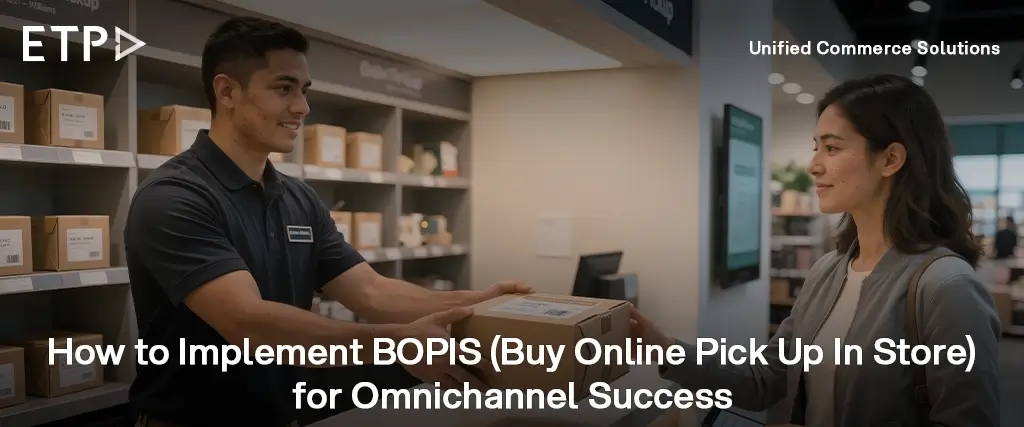
Buy Online Pick Up In Store (BOPIS) has evolved from a convenience feature into a strategic retail fulfilment model. As customers increasingly expect flexibility, speed, and inventory transparency, retailers must bridge the gap between digital and physical commerce.
Successful BOPIS execution requires more than offering in-store pickup. It demands real-time inventory visibility, intelligent order routing, seamless store operations, and integrated customer experiences. This is where omni-channel retail fulfillment, omni-channel OMS, and unified commerce POS platforms become essential.
Retailers that implement BOPIS effectively can improve customer satisfaction, increase store traffic, reduce fulfilment costs, and maximize inventory productivity across the network.
Why Is BOPIS Becoming Essential for Retail Growth?
Consumer expectations have fundamentally changed.
Customers no longer think in terms of channels. They simply want the fastest and most convenient way to purchase and receive products.
BOPIS addresses several key customer priorities:
- Faster order fulfilment
- Elimination of shipping fees
- Immediate product access
- Flexible collection options
- Greater confidence in inventory availability
For retailers, the benefits extend far beyond convenience.
BOPIS helps reduce last-mile delivery costs, increase store footfall, improve inventory utilization, and create additional upselling opportunities during pickup visits.
Expert Insight: BOPIS is not simply a fulfilment option. It is a customer experience strategy that connects digital demand with physical retail assets.
What Prevents Retailers from Successfully Implementing BOPIS?
While many retailers offer in-store pickup, few deliver a truly seamless experience. The challenge lies in operational complexity.
Inventory Inaccuracy
Many retailers lack real-time visibility into store inventory, leading to cancelled orders and customer disappointment.
Disconnected Order Management
Without centralized order orchestration, retailers struggle to determine which store should fulfil an order.
Store Execution Challenges
Store associates often lack tools and workflows to efficiently pick, stage, and hand over orders.
Technology Silos
e-Commerce, POS, inventory, and fulfilment systems frequently operate independently, creating delays and inconsistencies.
These challenges become even more significant for retailers operating across multiple regions, countries, or store formats.
What Technology Foundations Are Required for BOPIS Success?
Retail leaders often focus on the customer-facing aspects of BOPIS while overlooking the technology infrastructure required to support it.
Successful BOPIS programs typically rely on three foundational capabilities:
1. Omni-Channel Retail Fulfillment
Effective omni-channel retail fulfillment enables retailers to fulfill orders from the most appropriate location based on inventory availability, customer proximity, and operational capacity.
This allows stores to function as both sales channels and fulfilment nodes.
Key capabilities include:
- Real-time inventory visibility
- Store-based fulfilment
- Click-and-collect workflows
- Ship-from-store capabilities
- Intelligent order routing
Without these capabilities, BOPIS becomes difficult to scale.
2. Omni-channel OMS
An omni-channel OMS (Order Management System) acts as the orchestration layer that connects all commerce channels.
The OMS determines:
- Where inventory is available
- Which location should fulfil the order
- How customer pickup preferences should be managed
- When notifications should be triggered
A modern OMS helps retailers balance inventory availability, fulfilment speed, and operational efficiency.
Expert Insight: Retailers that rely on disconnected order systems often struggle with delayed fulfilment and inventory conflicts. An omni-channel OMS creates a single source of truth for every customer order.
3. Unified Commerce POS
A unified commerce POS extends beyond transaction processing.
It enables store associates to:
- View pickup orders
- Confirm inventory availability
- Manage order handovers
- Access customer information
- Process returns and exchanges
When integrated with OMS and inventory systems, the POS becomes a critical component of successful BOPIS execution.
How Does BOPIS Fit into a Unified Commerce Strategy?
Many retailers treat BOPIS as a standalone initiative.
Leading retailers approach it differently.
They view BOPIS as one component of a broader unified commerce strategy.
Unified commerce creates a single view of:
- Inventory
- Customers
- Orders
- Promotions
- Fulfilment operations
This unified foundation enables retailers to support multiple fulfilment models simultaneously:
- Buy Online Pick Up In Store
- Reserve Online Pick Up In Store
- Ship From Store
- Curbside Pickup
- Endless Aisle
- Same-Day Delivery
Rather than building separate systems for each fulfilment model, unified commerce creates a scalable operational framework.
A Practical Framework for Implementing BOPIS
Step 1: Establish Real-Time Inventory Visibility
Accurate inventory data is the foundation of every successful BOPIS program.
Retailers should ensure inventory updates occur in real time across stores, warehouses, marketplaces, and e-Commerce channels.
Step 2: Deploy Intelligent Order Management
An omni-channel OMS should automatically determine the optimal fulfilment location based on inventory, distance, and store workload.
Step 3: Standardize Store Fulfilment Processes
Store teams need clear workflows for:
- Order picking
- Quality checks
- Order staging
- Customer pickup verification
Operational consistency directly impacts customer satisfaction.
Step 4: Enable Associate Productivity
Store associates require mobile and POS-based tools that simplify order management and customer interactions.
Step 5: Measure Fulfilment Performance
Retailers should track:
- Order readiness times
- Pickup completion rates
- Order cancellation rates
- Inventory accuracy
- Customer satisfaction metrics
Continuous optimization is essential as order volumes grow.
How ETP Enables Scalable Omni-Channel Fulfilment
As BOPIS adoption increases, retailers require technology platforms capable of orchestrating complex fulfilment operations across the enterprise.
ETP Group helps retailers implement scalable omni-channel retail fulfillment through a unified commerce architecture that connects inventory, stores, warehouses, customers, and orders in real time.
Capabilities include:
- Enterprise-grade omni-channel OMS
- Unified commerce POS
- Real-time inventory visibility
- Intelligent order orchestration
- Store fulfilment management
- Customer order tracking
By creating a single operational foundation, retailers can support BOPIS and future fulfilment models without increasing system complexity.
Is Your Business Ready for BOPIS?
Before launching or expanding a BOPIS program, ask the following:
- Can customers view accurate store inventory online?
- Does your OMS automatically route orders to the optimal fulfilment location?
- Can store associates manage pickup orders efficiently?
- Is inventory synchronized across all channels in real time?
- Can your POS support pickup, returns, and exchanges seamlessly?
- Do you have visibility into fulfilment performance metrics?
- Can your technology support future fulfilment models beyond BOPIS?
If the answer to several of these questions is "no," your fulfilment infrastructure may require modernization.
Final Thoughts
BOPIS is no longer an optional service enhancement. It has become a core requirement for retailers seeking to compete in an increasingly omni-channel marketplace.
However, successful BOPIS implementation depends on much more than offering store pickup. It requires connected inventory, intelligent order orchestration, efficient store operations, and a robust unified commerce foundation.
Retailers that invest in omni-channel retail fulfillment, omni-channel OMS, and unified commerce POS capabilities are better positioned to deliver seamless customer experiences while improving operational efficiency and profitability.
The future of retail fulfilment belongs to organizations that can turn every store into a connected commerce hub.
Ready to build a future-ready fulfilment strategy?
Discover how ETP Group helps retailers implement unified commerce, intelligent order management, and scalable omni-channel fulfilment. Book a demo with our retail experts today.
Common Questions Retailers Ask
What is BOPIS in retail?
BOPIS (Buy Online, Pick Up In Store) allows customers to place orders online and collect products from a physical store rather than opting for home delivery.
Why is omni-channel OMS important for BOPIS?
An omni-channel OMS manages inventory visibility, order routing, and fulfilment workflows, ensuring orders are fulfilled accurately and efficiently.
What is omni-channel retail fulfillment?
Omni-channel retail fulfillment refers to the ability to fulfil customer orders using inventory across stores, warehouses, marketplaces, and digital channels through a connected operational network.
How does a unified commerce POS support BOPIS?
A unified commerce POS allows store associates to manage pickup orders, verify inventory, access customer information, and complete fulfilment workflows within a single platform.