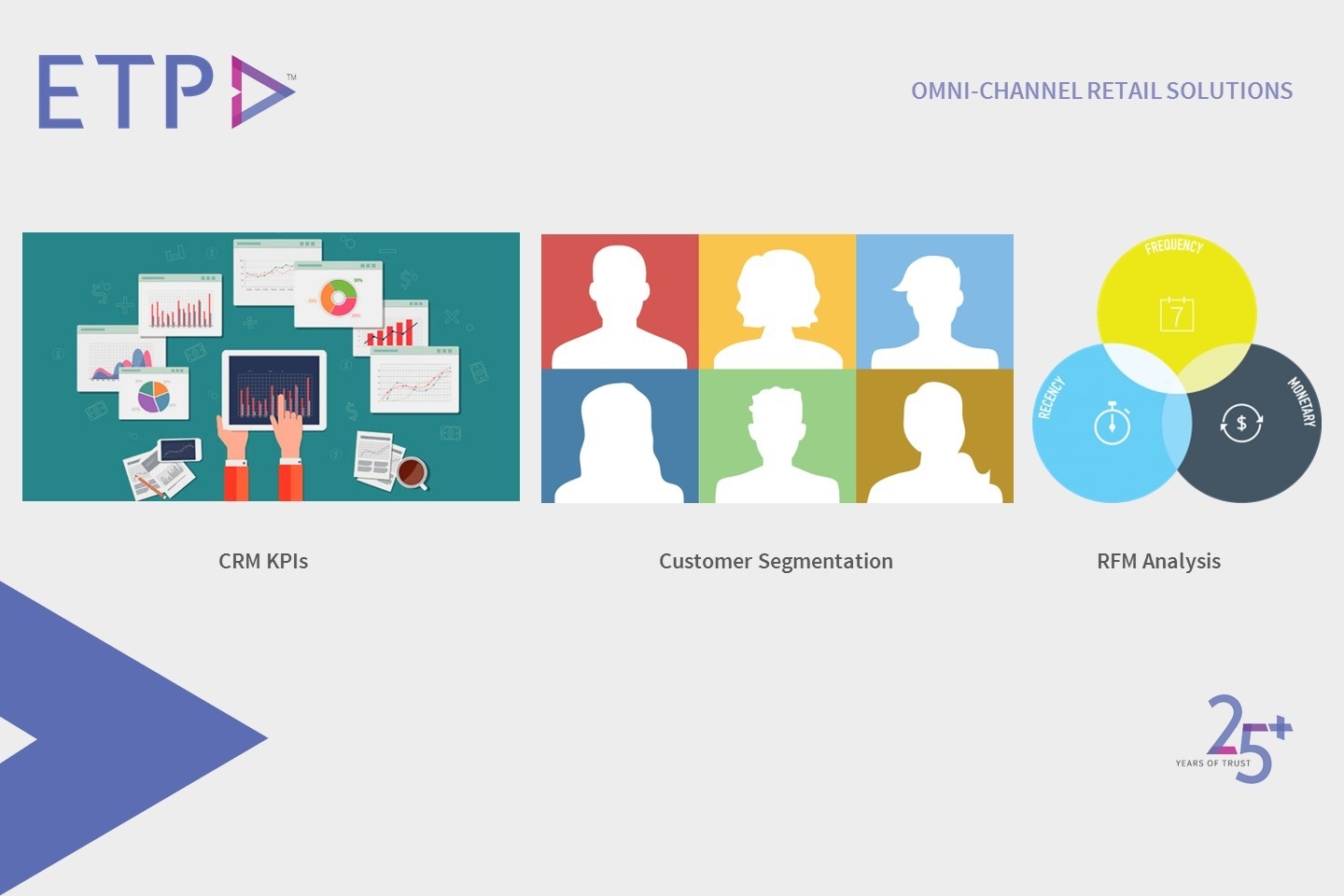
Customer Relationship Management (CRM) may be perceived as an enhanced customer retention and loyalty strategy. Modern day CRM systems can help retailers achieve much beyond that. Using an efficient CRM system, retailers can now strategize the demand increment while optimally planning the supply or resources required at every process stage. The key methods here are:
CRM KPIs: Retailers can deem a retail operation successful on the basis of profitability (short-term or long-term). Through CRM, retailers can redefine the rationale behind his retail activities and ascertain how they should affect the end consumer. This entails defining the purpose of the activity and attributing the right resources to the right opportunities by studying the past, present and future business positioning. Armed with this knowledge, retailers can better understand the viability of his CRM definitions with respect to the market dynamism.
Customer Segmentation: This refers to the segmentation basis the demographical/geographical and physiographical/behavioral parameters pertaining to the customers. The former presents the ‘visible’ characteristics which can be derived through registrations; while the latter constitutes characteristics which can be derived through deeper analysis. This helps retailers administer the right amount of engagement through the right channels and even define the business rules which allow different customers to be treated differently.
RFM Analysis: Although this forms a part of the customer segmentation process, the exceptional value derived through this analysis validates its special mention. RFM stands for Recency, Frequency, Monetary Analysis; Recency denotes how long ago the customer last made a purchase, Frequency specifies how many purchases the customer has made (within a specified time period), Monetary is total monies spent by the customer (within a specified time period). This analysis helps retailers to optimize their marketing and promotion spending, ensuring accurate targeting of key customers, basis the activity strategy.
Good customer relationships are the result of ‘the right product, for the right customer, in the right place, at the right time, in the right quantity, in the right condition, and at the right cost’. CRM is a way to identify each of these ‘rights’ and to segment customers accordingly.
- 온라인 매장과 오프라인 매장을 하나의 일관된 고객 경험으로 통합하는 방법 (몇 달 동안의 번거로운 통합 과정 없이).
- AI 기반 인사이트를 활용하여 재고를 관리하고, 낭비를 줄이며, 모든 채널에서 매출을 극대화합니다.
- ETP의 플랫폼이 현재 주요 소매업체들에게 어떻게 가시적인 효율성 향상과 상당한 매출 증대를 가져다주고 있는지에 대한 실제 사례.