How Unified Commerce POS Supports Endless Aisle Shopping in Retail Stores
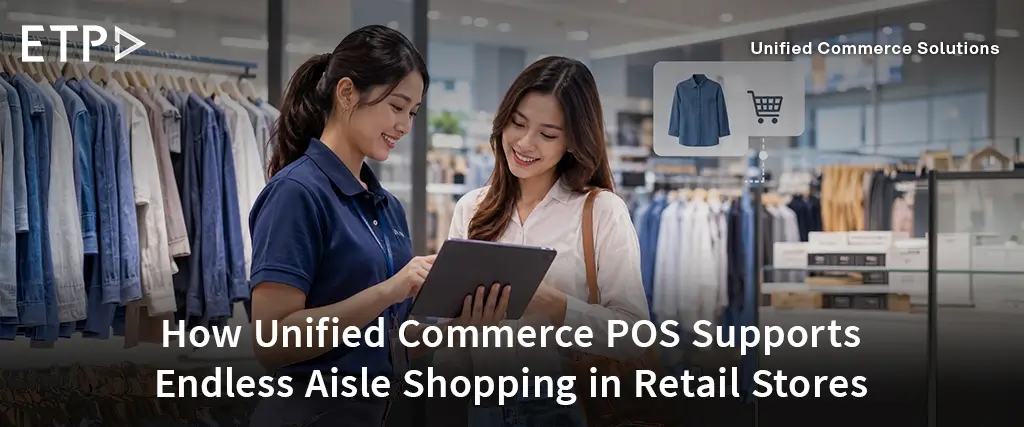
A customer walks into a fashion store looking for a particular jacket. They find the right style, but the store does not have their size. The associate checks another outlet and finds the item in stock. Instead of losing the sale, the retailer can offer an alternative way to complete the purchase.
This is the idea behind endless aisle shopping. Customers can explore products beyond what is physically available in the store, while associates help them find and order the items they want.
A unified commerce POS can support this experience by connecting in-store sales activities with product availability and relevant retail systems. When combined with accurate inventory information and suitable fulfilment options, it gives retailers more ways to serve customers when a product is missing from the shelf.
What Is Endless Aisle Shopping in Retail?
Endless aisle shopping allows customers to access a retailer's wider product assortment even when a particular item is unavailable at their current store.
Instead of treating the products on the shop floor as the limit of what they can buy, customers can receive assistance finding items available through other stores or supported sales channels.
Consider a footwear retailer with multiple outlets. A customer finds a pair of shoes they like, but the store only has the product in two sizes. If the required size is available at another location, the associate may be able to help arrange an order, subject to the retailer's inventory and fulfilment processes.
Endless aisle can be particularly useful for retailers selling products with multiple sizes, colours, styles or configurations. Fashion, footwear, beauty and consumer electronics are examples of categories where customers may want a specific variant that is not available at every outlet.
The concept depends on more than access to a digital catalogue. Retailers need reliable product information, visibility into stock availability and a way to fulfil orders placed through the store.
How Unified Commerce POS Makes Endless Aisle Possible
A traditional checkout system primarily supports transactions at the point of sale. A unified commerce POS can play a broader role when connected to inventory, customer and order management capabilities.
Here is how that connection can support endless aisle shopping.
1. Find products beyond the physical store
When an item is unavailable on the shelf, the first step is to establish whether it can be sourced elsewhere.
Store associates need access to relevant product information and stock availability across the retailer's network. Depending on the system configuration, this may include other stores or inventory held at warehouses.
For example, a customer shopping at a store in Jakarta may be looking for a particular colour of a product that is available at another branch. With connected inventory information, the associate can check the available options and explain what can be arranged.
Inventory visibility needs to be sufficiently accurate for associates to make useful recommendations. Retailers should also understand how stock reservations, pending orders and inventory updates affect the availability shown to staff.
2. Help customers place orders in-store
Once the required product has been identified, the next step is completing the purchase.
A suitable endless aisle setup allows store associates to help customers order products that are not physically available at that outlet. The order process should make it clear which item is being purchased, its price, the expected fulfilment arrangement and any relevant delivery or collection details.
This is where POS integration matters. Associates should not have to rely on disconnected applications or manual communication to complete every step.
The precise ordering workflow depends on the retailer's POS, order management and fulfilment configuration.
3. Offer suitable fulfilment options
Finding the product is only part of the customer journey. The retailer also needs a way to get it to the customer.
Depending on its operating model, the business may support delivery to the customer's address, collection from a designated store or another configured fulfilment option.
For instance, a customer who cannot find their size in one outlet may prefer home delivery rather than travelling to another branch. Another customer may be happy to collect the item from a nearby store.
Retailers should establish which locations can fulfil an order, whether the item can be reserved and how customers will receive updates. The options available will depend on inventory accuracy, order management capabilities and store processes.
4. Keep the transaction connected to store operations
Endless aisle should fit into the retailer's existing sales and service processes.
The POS needs to work with the relevant systems responsible for product information, pricing, inventory and order handling. This helps associates manage the transaction using consistent information instead of treating an endless aisle purchase as an entirely separate activity.
Retailers should also clarify how these orders are recorded, how returns and exchanges are handled, and how staff can track an order after it has been placed.
A connected process makes it easier for the customer and the associate to understand what happens next.
What Happens When a Product Is Out of Stock In-Store?
An unavailable product does not always have to mean a lost sale. The next step is to determine what alternatives the retailer can genuinely offer.
A practical endless aisle workflow might look like this:
- Identify the product: The associate confirms the customer's preferred item, size, colour or model.
- Check availability: The associate uses the connected system to review relevant stock information.
- Present available options: The customer can consider a different variant, another store or an available delivery or collection option.
- Place the order: The associate completes the supported ordering process and confirms the purchase details.
- Explain fulfilment: The customer receives clear information about the next steps, including delivery or collection arrangements where applicable.
Each step relies on accurate information and clearly defined store procedures. If stock is already committed to another order, for example, the system and workflow need to account for that before an associate promises availability.
Retailers should also establish how staff handle cases where the inventory record does not match the physical stock.
Also read: Unified Commerce POS Pricing: A Complete Guide
Why Inventory Visibility Matters for Endless Aisle
Endless aisle can only work as intended when associates have useful information about where products are available.
If inventory data is fragmented across stores, warehouses and online channels, staff may struggle to determine whether an item can actually be supplied. A product might appear available in one system even though it has already been sold, reserved or moved.
Unified inventory visibility helps retailers bring relevant stock information together so that product availability can inform customer service and order decisions.
This requires more than displaying a stock number. Retailers should consider how frequently information is updated, how stock movements are recorded and how the system distinguishes available inventory from stock that is already committed.
Connected inventory also supports broader retail operations. The same information may help teams make decisions about replenishment, transfers and order fulfilment.
For retailers evaluating a unified commerce platform, inventory visibility should therefore be assessed alongside POS and order management functionality.
What Should Retailers Consider When Implementing Endless Aisle?
Before introducing endless aisle shopping, retailers should assess whether their systems and store processes can support the full customer journey.
Inventory accuracy
Check whether the solution provides visibility across the locations relevant to the business and how it handles reservations, stock movements and inventory updates.
POS and order management integration
Confirm how the POS connects with the systems used to create, track and fulfil orders. Understand which steps are automated and which require staff intervention.
Fulfilment processes
Define which stores or warehouses can fulfil endless aisle orders, how delivery or collection options are selected and how exceptions are handled.
Associate experience
The process should be straightforward enough for staff to use while assisting customers. Product search, stock checks and order placement should fit naturally into the store's workflow.
Customer communication
Customers should know what they have ordered, how they will receive it and what to do if the order is delayed or needs to be changed.
Returns and exchanges
Establish how endless aisle purchases are handled when customers need a different size, want to return an item or have an issue with the order. The process should be clear to both store associates and customers.
These considerations help retailers assess whether endless aisle can operate reliably across their store network rather than functioning as an isolated ordering feature.
How ETP Unify Cloud POS Supports Endless Aisle Shopping
ETP Unify brings together retail capabilities designed to connect store operations and customer experiences across channels. Its published product information identifies Cloud POS and Retail Operations as part of the platform, with features including endless aisle, click and collect, and omnichannel returns and exchanges.
The platform's Cloud POS also includes an in-transaction CRM system supporting customer registration, billing, orders, returns and promotions. These capabilities provide context for how POS can contribute to a connected retail experience.
For endless aisle, the important consideration is how the POS works with the retailer's inventory and order processes. Store associates need to be able to identify the product a customer wants and follow the configured process for completing and fulfilling the order.
The broader ETP Unify platform also brings together capabilities such as inventory management and order management, which are relevant when retailers want to connect product availability with fulfilment decisions.
Retailers evaluating the solution should confirm the specific workflows, integrations and fulfilment options available for their intended implementation.
Turn Product Availability into More Selling Opportunities
A product missing from the shelf does not have to end the conversation with the customer. With the right combination of unified commerce POS, inventory visibility and fulfilment processes, retailers can offer alternatives that help customers find what they came to buy.
Endless aisle works best when the experience extends beyond finding a product. Associates need a reliable way to place the order, and the retailer needs a process for getting it to the customer.
Explore ETP Unify Cloud POS and Retail Operations to see how connected POS capabilities can support endless aisle shopping. Book a demo!
Common Questions Retail Leaders Ask
What is endless aisle shopping in retail?
Endless aisle shopping allows customers to access a retailer's wider product assortment even when an item is unavailable at their current store. Depending on the retailer's systems and fulfilment options, the customer may be able to order the item for delivery or collection.
How does unified commerce POS support endless aisle?
A unified commerce POS can connect in-store sales activities with product information, inventory and order management capabilities. This helps store associates check product availability, assist with orders and guide customers through the available fulfilment options.
How does endless aisle work when a product is unavailable in-store?
The associate checks whether the product is available elsewhere in the retailer's network. If the item can be supplied, the retailer can offer a supported ordering and fulfilment option, such as delivery or collection. The process depends on accurate inventory information and the retailer's operating setup.
What is the role of inventory visibility in endless aisle retail?
Inventory visibility helps associates identify where a product may be available and whether it can be supplied to a customer. Accurate stock information is essential for making reliable availability promises and avoiding orders that cannot be fulfilled.
Can endless aisle orders be fulfilled from another store?
Yes, if the retailer's systems and operating processes support fulfilment from another store. The business needs to confirm stock availability, order routing, store responsibilities and the delivery or collection arrangements before offering this option.
What should retailers look for in an endless aisle POS solution?
Retailers should assess inventory visibility, product search, POS and order management integration, fulfilment options, associate usability and the handling of returns and exchanges. They should also check how the solution manages stock reservations and keeps customers informed about their orders.
- Cara menyatukan toko online dan toko fisik Anda menjadi satu pengalaman pelanggan yang terpadu (tanpa harus repot menghabiskan berbulan-bulan untuk proses integrasi).
- Memanfaatkan wawasan berbasis kecerdasan buatan (AI) untuk mengelola persediaan, mengurangi limbah, dan memaksimalkan penjualan di seluruh saluran.
- Contoh nyata tentang bagaimana platform ETP saat ini memberikan peningkatan efisiensi yang terukur dan lonjakan pendapatan yang signifikan bagi para pengecer terkemuka.