Quick Commerce in Retail: Transforming E-Grocery and Beyond
Consumer expectations have evolved rapidly in recent years. Today's shoppers expect groceries, daily essentials, electronics, and even fashion products to be delivered within hours—or sometimes even minutes. This growing demand for speed and convenience has fuelled the rise of quick commerce (q-commerce), transforming how retailers manage inventory, fulfil orders, and serve customers.
However, delivering products quickly requires much more than fast delivery partners. Retailers need accurate Retail Inventory Management, efficient Retail Fulfilment, and connected omni-channel Retail operations to ensure products are always available and orders are fulfilled from the right location.
As quick commerce continues to reshape the retail landscape, businesses that invest in modern retail technology will be better positioned to improve customer satisfaction, reduce operational costs, and stay ahead of the competition.
What is Quick Commerce?
Quick commerce, commonly known as q-commerce, is the next evolution of eCommerce that focuses on ultra-fast order fulfilment. Unlike traditional online shopping, where deliveries can take several days, quick commerce aims to deliver products within minutes or a few hours.
Initially popular in the grocery sector, quick commerce has rapidly expanded into categories such as health and beauty, pharmacy, electronics, home essentials, and fashion. Consumers increasingly expect instant access to products, making speed a key differentiator for modern retailers.
For retailers, quick commerce is no longer simply about faster delivery—it is about building agile operations capable of meeting rising customer expectations while maintaining profitability.
How Quick Commerce Works
Behind every successful quick commerce operation is a well-connected retail ecosystem powered by intelligent technology.
Retailers use strategically located dark stores and micro-fulfilment centres to keep high-demand products closer to customers. Orders are automatically processed and routed to the nearest fulfilment location, helping reduce delivery times and transportation costs.
Modern quick commerce platforms also rely on advanced technologies such as:
- Real-time inventory visibility
- AI-powered demand forecasting
- Smart Order Management
- Automated order routing
- Route optimization
- Centralized Retail Inventory Management
Together, these technologies enable retailers to process thousands of orders accurately while maintaining inventory availability across stores and warehouses.
Want to build a true unified commerce foundation? Discover how ETP’s unified commerce approach can help you create connected experiences, real-time visibility, and scalable growth across every channel.
Why Quick Commerce is Transforming Grocery Retail
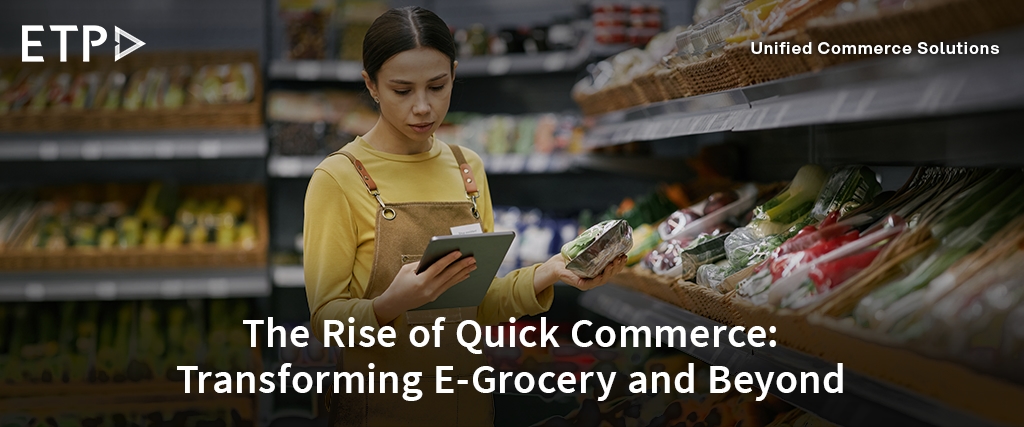
Among all retail sectors, grocery has experienced the biggest impact from quick commerce. Fresh produce, dairy products, packaged foods, and daily essentials are now expected to be available for delivery almost instantly.
This shift has made Grocery Retail Management significantly more complex. Retailers must balance inventory across stores, fulfilment centres, and online channels while ensuring freshness, pricing accuracy, and rapid order processing.
To succeed, grocery retailers need connected systems that provide:
- Real-time inventory visibility across every location
- Faster order processing and fulfilment
- Accurate pricing and promotions
- Efficient replenishment
- Flexible delivery and pickup options
Retailers that can meet these expectations not only improve customer satisfaction but also increase repeat purchases and long-term loyalty.
Benefits of Quick Commerce for Grocery Retailers
Faster Retail Fulfilment
Speed is at the heart of quick commerce. Automated order routing ensures orders are fulfilled from the nearest available location, helping retailers reduce delivery times while lowering fulfilment costs.
Better Retail Inventory Management
Accurate inventory is critical for preventing cancelled orders and stock discrepancies. Modern Retail Inventory Management solutions synchronize inventory across stores, warehouses, and digital channels, allowing retailers to maintain optimal stock levels and improve inventory accuracy.
Improved Customer Experience
Customers expect products to be available when and where they need them. Real-time inventory visibility enables retailers to offer reliable delivery promises, Click & Collect services, and accurate product availability across every sales channel.
Increased Operational Efficiency
Automation reduces manual inventory updates, order processing delays, and fulfilment errors. Store teams spend less time managing inventory and more time serving customers, improving productivity across the business.
Omni-channel Retail is Powering the Growth of Quick Commerce
Quick commerce cannot succeed without connected omni-channel retail operations.
Today's customers interact with brands through multiple touchpoints, including physical stores, brand websites, mobile apps, online marketplaces, and social commerce platforms. They expect a consistent shopping experience regardless of where they choose to shop.
To meet these expectations, retailers need a unified technology platform that connects inventory, fulfilment, pricing, promotions, and customer data across every channel.
An integrated omni-channel strategy enables retailers to:
- Synchronize inventory across stores and warehouses.
- Offer Buy Online, Pick Up In-Store (BOPIS) and Ship-from-Store services.
- Deliver consistent pricing and promotions across all channels.
- Improve fulfilment speed while reducing operational complexity.
- Create a seamless customer journey from purchase to delivery.
By combining Retail Inventory Management with intelligent Retail Fulfilment, retailers can respond faster to customer demand while maximizing inventory availability and improving profitability.
Quick Commerce Beyond Grocery
While grocery retail continues to lead the adoption of quick commerce, the model is rapidly expanding across multiple retail sectors. Consumers now expect the same speed and convenience when shopping for fashion, beauty products, electronics, home essentials, pharmacy items, and pet supplies.
For retailers, this presents new opportunities to improve customer experiences while increasing sales across channels. However, success depends on having connected operations that support fast and accurate Retail Fulfilment, inventory visibility, and seamless order management.
As more industries embrace quick commerce, businesses need scalable retail technology that enables them to fulfil orders efficiently while maintaining profitability.
Challenges Retailers Must Overcome
Inventory Accuracy
Fast deliveries rely on accurate inventory data. Even minor inventory discrepancies can result in cancelled orders, delayed deliveries, and disappointed customers. Modern Retail Inventory Management solutions provide real-time inventory visibility to help retailers maintain stock accuracy across stores, warehouses, and fulfilment centres.
Last-Mile Fulfilment
Meeting ultra-fast delivery promises requires intelligent order routing and efficient fulfilment operations. Retailers need systems that automatically allocate orders to the most appropriate fulfilment location, reducing delivery times while controlling logistics costs.
Managing Promotions Across Channels
Quick commerce shoppers are highly responsive to discounts and limited-time offers. Retailers must ensure promotions remain consistent across stores, websites, mobile apps, and marketplaces. A centralized Unified Promotions Management solution helps deliver personalized offers while eliminating pricing inconsistencies across sales channels.
Sustainability
As delivery volumes increase, retailers must also consider environmental impact. Optimized delivery routes, consolidated shipments, and efficient inventory planning help reduce transportation costs, packaging waste, and carbon emissions while supporting more sustainable retail operations.
How ETP Enables Modern Grocery Retail Management
Speed alone does not define successful quick commerce. Behind every fast delivery is a connected retail ecosystem that combines inventory visibility, intelligent fulfilment, promotions, and store operations.
ETP empowers grocery retailers with a unified commerce platform designed to support the demands of modern Grocery Retail Management.
Through Retail Inventory Management, retailers gain real-time visibility into inventory across stores, warehouses, and fulfilment centres, ensuring products remain available while reducing stock discrepancies.
Integrated Smart Order Management intelligently routes customer orders to the most suitable fulfilment location based on inventory availability, customer proximity, and delivery efficiency. This helps retailers accelerate Retail Fulfilment while minimizing operational costs.
ETP also enables retailers to manage promotions consistently across every sales channel through Unified Promotions Management, ensuring customers receive the same offers whether they shop in-store, online, or through a marketplace.
For grocery retailers, ETP offers capabilities specifically designed for high-volume, fast-moving environments, including:
- Touchscreen POS with intuitive checkout workflows
- Weighing scale integration for fresh produce
- Selling products in decimal quantities
- Multiple retail price management
- Real-time promotional pricing
- Integrated customer loyalty programmes
- Real-time inventory synchronization
- Cloud-native architecture that supports business growth
Together, these capabilities help retailers improve operational efficiency, enhance customer experiences, and successfully scale their quick commerce operations.
The Future of Quick Commerce
Quick commerce continues to evolve as retailers invest in AI, automation, and cloud-native technologies to meet rising customer expectations.
Over the next few years, retailers will increasingly rely on artificial intelligence to forecast demand, automate replenishment, optimize inventory allocation, and improve delivery planning. Machine learning will help retailers predict buying patterns more accurately, reducing inventory waste while ensuring products remain available when customers need them.
Automation will also play a larger role in fulfilment operations, enabling retailers to process growing order volumes with greater speed and accuracy.
At the same time, connected omni-channel retail strategies will become even more important. Customers will expect a seamless shopping experience across physical stores, eCommerce websites, mobile apps, marketplaces, and social commerce channels. Retailers that can unify inventory, fulfilment, pricing, and customer engagement across every touchpoint will be better positioned to compete in the evolving retail landscape.
Conclusion
Quick commerce is no longer limited to grocery deliveries—it has become a key growth strategy across modern retail. As customer expectations continue to evolve, retailers need connected technology that enables faster Retail Fulfilment, accurate Retail Inventory Management, and seamless Omni-channel Retail experiences.
By combining real-time inventory visibility, intelligent order management, unified promotions, and scalable store operations, retailers can improve efficiency while delivering the speed and convenience today's customers expect.
ETP's unified commerce solutions help grocery retailers streamline operations, optimize inventory, accelerate fulfilment, and create exceptional shopping experiences across every channel.
Whether you're expanding your eGrocery business or building a future-ready quick commerce strategy, ETP provides the technology foundation to help you grow with confidence.
Ready to transform your grocery retail operations? Discover how ETP's unified commerce solutions can help you optimize inventory, improve retail fulfilment, and deliver seamless omni-channel experiences. Book a demo today. Let’s connect!
Frequently Asked Questions
What is quick commerce in retail?
Quick commerce (q-commerce) is a retail model focused on delivering products within minutes or a few hours by using localized fulfilment centres, real-time inventory visibility, and efficient order management systems.
How does quick commerce improve grocery retail management?
Quick commerce enables grocery retailers to offer faster deliveries, accurate inventory visibility, efficient retail fulfilment, and seamless omni-channel shopping experiences, improving customer satisfaction and operational efficiency.
Why is Omni-channel retail important for quick commerce?
Omni-channel Retail connects inventory, fulfilment, promotions, and customer data across every sales channel, allowing retailers to deliver consistent shopping experiences while supporting faster and more accurate order fulfilment.
What technology supports successful quick commerce operations?
Successful quick commerce relies on technologies such as Retail Inventory Management, Smart Order Management, real-time inventory visibility, AI-powered demand forecasting, and Unified Promotions Management to streamline operations and improve fulfilment efficiency.
How does ETP support grocery retailers?
ETP helps grocery retailers manage inventory, automate retail fulfilment, optimize promotions, and deliver connected omni-channel experiences through its cloud-native unified commerce platform, enabling businesses to scale efficiently while meeting evolving customer expectations.
- Cara menyatukan toko online dan toko fisik Anda menjadi satu pengalaman pelanggan yang terpadu (tanpa harus repot menghabiskan berbulan-bulan untuk proses integrasi).
- Memanfaatkan wawasan berbasis kecerdasan buatan (AI) untuk mengelola persediaan, mengurangi limbah, dan memaksimalkan penjualan di seluruh saluran.
- Contoh nyata tentang bagaimana platform ETP saat ini memberikan peningkatan efisiensi yang terukur dan lonjakan pendapatan yang signifikan bagi para pengecer terkemuka.