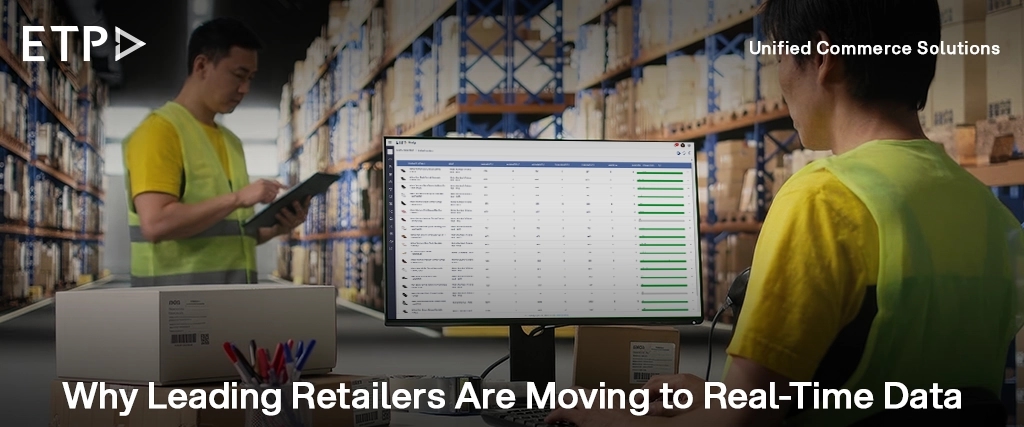
Modern retail operates in real time. Unfortunately, many retail decisions do not.
Across India, Southeast Asia, and APAC, retailers are facing an increasingly dangerous operational gap: leadership teams are making decisions based on delayed, fragmented, and incomplete data while customer expectations continue to accelerate.
By the time reports are consolidated, dashboards are updated, or inventory data is reconciled, the business reality has already changed.
This delay impacts everything:
- Inventory allocation
- Pricing decisions
- Order fulfilment
- Demand forecasting
- Store replenishment
- Customer experience
- Revenue recovery
Retailers no longer lose competitive advantage because they lack data. They lose because their data arrives too late to act on.
This is why enterprise retailers are increasingly investing in unified commerce, AI-driven operations, and real-time decision systems that enable faster, more accurate execution across the business.
According to research from McKinsey & Company, companies that leverage real-time data and AI-driven operational decision-making significantly improve agility, customer responsiveness, and operational efficiency.
Why Late Data Is Becoming a Major Retail Risk
Retail today moves at unprecedented speed.
A product trend can emerge overnight on social commerce. Demand spikes can occur regionally within hours. Inventory imbalances can spread across channels rapidly. Customer sentiment shifts instantly. Yet many retailers still rely on:
- 1
Overnight batch updates
Reporting cycles that run once per day leave operations flying blind between refreshes.
- 2
Spreadsheet-based reporting
Manual consolidation introduces errors and delays that compound across the decision chain.
- 3
Disconnected POS systems
Point-of-sale data that does not feed into a central platform creates visibility gaps at the transaction level.
- 4
Delayed ERP synchronization
Enterprise systems that sync on a schedule rather than in real time propagate stale data enterprise-wide.
- 5
Manual inventory reconciliation
Human-driven stock counts that run periodically cannot keep pace with live demand and fulfilment activity.
This creates a dangerous lag between operational reality and executive decision-making.
Retailers may think inventory is available when it has already sold out. Pricing teams may react too late to changing demand patterns. Fulfilment teams may discover stock issues only after orders fail.
Retailers that rely on disconnected commerce systems often struggle with inaccurate inventory, delayed fulfilment, and reactive operations. Unified commerce platforms address this by creating a single operational view across all retail channels.
What Happens When Retail Decisions Are Delayed?
- 1
Inventory Problems Escalate Faster
Without real-time visibility, inventory distortion increases. Retailers experience:
- Overstocking in low-demand regions
- Stockouts in high-demand locations
- Slow-moving inventory accumulation
- Delayed replenishment decisions
According to Deloitte Insights, inventory inefficiencies remain one of the largest operational cost drivers in modern retail.
- 2
Customer Experience Breaks Down
Customers now expect:
- Accurate stock availability
- Same-day fulfilment
- Flexible delivery options
- Seamless omni-channel shopping
When data is delayed:
- Orders get cancelled
- Delivery timelines fail
- Store associates lack visibility
- Customer trust declines
In unified retail environments, operational responsiveness directly influences customer loyalty.
- 3
Leadership Teams Become Reactive
Many retail organizations spend more time diagnosing problems than preventing them.
Delayed operational visibility creates:
- Slow executive response times
- Reduced forecasting accuracy
- Higher fulfilment costs
- Fragmented decision-making
Leadership teams cannot optimize operations effectively if the underlying data is outdated.
Why Unified Commerce Is Emerging as the Operational Backbone
Modern retailers are shifting from siloed retail systems toward connected ecosystems powered by unified commerce strategy.
Unlike traditional omni-channel models that loosely connect separate systems, unified commerce centralizes:
- Inventory
- Orders
- Customer data
- Fulfilment
- Store operations
- Warehouse visibility
This creates a single source of truth across the enterprise.
The result:
- Faster decisions
- Better operational visibility
- More accurate forecasting
- Improved fulfilment orchestration
- Stronger customer experiences
How AI-Powered Retail Solutions Improve Decision-Making
The rise of AI for retail industry operations is accelerating the transition toward predictive and real-time retail execution.
AI-powered retail systems can:
- Predict demand fluctuations
- Optimize replenishment
- Detect inventory anomalies
- Improve order routing
- Identify fulfilment bottlenecks
- Forecast regional buying trends
This enables retailers to move from reactive operations to proactive decision-making.
According to Statista, AI adoption in retail continues to grow rapidly as retailers seek operational agility and improved customer personalization.
The Shift Toward Cloud Native Retail Software
Legacy retail infrastructure often struggles to support real-time commerce demands.
Modern retailers increasingly require:
- Scalability across regions
- Faster integrations
- Continuous operational visibility
- API-first architecture
- Real-time synchronization
This is why many enterprise retailers are adopting cloud native retail software architectures that support agility, scalability, and faster deployment cycles.
Cloud-native systems enable retail organizations to adapt more quickly to evolving customer behaviour and operational complexity.
Signs Your Retail Organization Has a Data Latency Problem
If your teams experience the following regularly, delayed data may be affecting operational performance:
- Inventory reports lag behind actual stock movement
- Order fulfilment failures increase unexpectedly
- Store teams lack real-time inventory access
- Forecasting accuracy continues declining
- Leadership decisions rely on yesterday's reports
- Customer complaints about stock availability increase
- Replenishment cycles feel reactive
- e-Commerce and store inventory frequently mismatch
How Leading Retailers Are Fixing the Problem
Retail leaders are investing in connected operational ecosystems powered by:
- Unified commerce platforms
- Real-time inventory synchronization
- AI-driven forecasting
- Intelligent fulfilment orchestration
- Centralized operational visibility
These capabilities enable businesses to make decisions using live operational data rather than delayed reporting cycles.
Retailers adopting unified commerce infrastructure gain the ability to:
- Respond faster to demand shifts
- Improve inventory utilization
- Reduce operational inefficiencies
- Increase fulfilment speed
- Enhance customer satisfaction
How ETP Unify Enables Real-Time Retail Decision-Making
ETP Unify helps retailers create a connected operational ecosystem across stores, warehouses, fulfilment, and digital channels. With unified commerce capabilities, retailers can:
- Gain real-time operational visibility
- Synchronize inventory across channels
- Enable intelligent order management
- Improve fulfilment agility
- Reduce decision-making delays
- Support scalable omni-channel operations
By centralizing retail operations through a unified commerce framework, businesses can operate faster, smarter, and with greater accuracy.
Explore how ETP Group Unified Commerce Solutions enable modern retailers to make real-time decisions across complex commerce environments.
Final Takeaway
Retail operations are becoming too dynamic for delayed decision-making.
Disconnected systems and outdated reporting cycles create operational blind spots that directly affect revenue, fulfilment performance, and customer satisfaction.
Leading retailers are solving this challenge by investing in:
The future of retail belongs to organizations that can see operational changes as they happen and act immediately.
Discover how ETP Unify helps retailers enable real-time visibility, intelligent fulfilment, and faster enterprise decision-making.
Ready to modernize your retail operations?
Book a Demo with ETP Experts
Common Questions Retailers Ask
What is unified commerce in retail?
Unified commerce is a retail operating model where inventory, orders, fulfilment, customer data, and store operations are managed through a centralized platform in real time.
Why is real-time data important in retail?
Real-time data enables retailers to make faster operational decisions, improve inventory accuracy, optimize fulfilment, and enhance customer experience.
How does AI help the retail industry?
AI-powered retail solutions help retailers forecast demand, automate replenishment, optimize fulfilment, personalize customer experiences, and improve operational efficiency.
Why are retailers adopting cloud native retail software?
Cloud native retail software provides scalability, agility, real-time synchronization, and faster integration capabilities required for modern commerce operations.
- Cara menyatukan toko online dan toko fisik Anda menjadi satu pengalaman pelanggan yang terpadu (tanpa harus repot menghabiskan berbulan-bulan untuk proses integrasi).
- Memanfaatkan wawasan berbasis kecerdasan buatan (AI) untuk mengelola persediaan, mengurangi limbah, dan memaksimalkan penjualan di seluruh saluran.
- Contoh nyata tentang bagaimana platform ETP saat ini memberikan peningkatan efisiensi yang terukur dan lonjakan pendapatan yang signifikan bagi para pengecer terkemuka.