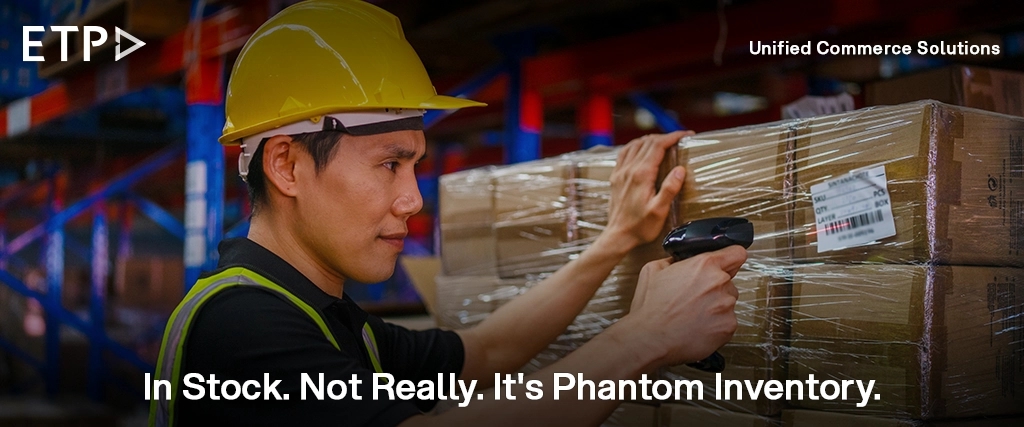
Picture this: a customer searches for a product online. Your store inventory management software shows it as in stock. They drive to your store, ask a sales associate, only to find the shelf is empty. Your associate checks the system. It still says the product is there. But it isn’t.
This is PHANTOM INVENTORY. And it isn’t a fringe anomaly. It is one of the most pervasive, most financially damaging, and least visible problems in retail operations today.
The system says it’s there. The shelf says otherwise.
The gap between what your inventory warehouse management system records and what physically exists on your shelves, or in your warehouse, or across your omnichannel network, is what we call the data trust gap. And in a world where a customer’s patience is measured in seconds and their loyalty is hard-won, this gap is quietly eroding revenue, trust, and competitive edge.
The Scale of the Problem: It’s Bigger Than You Think
Phantom inventory is not a new problem. But its consequences have never been more severe. According to research by IHL Group, the global retail industry loses $1.73 trillion annually due to inventory distortion; the combined cost of out-of-stocks and overstocks, representing 6.5% of global retail sales1.
Out-of-stocks alone account for $1.2 trillion of that figure, with phantom inventory, stock the system believes exists but doesn’t, a leading, largely invisible driver.
Industry research shows that phantom inventory accounts for an average of 8% of all inventory losses, meaning for every $100 in inventory, $8 is effectively phantom. Compounding this, the National Retail Federation reports that total retail shrinkage, a significant source of phantom stock, cost the industry $112.1 billion in a single year, a figure that has only grown since2.
For omni-channel retailers, the stakes are even higher. Without a reliable unified inventory management system, traditional inventory methods average just 60–65% accuracy at item level. The result: order cancellations, mismatched fulfilment, and customers who experience your brand’s broken promise firsthand.
According to IHL Group, retailers using AI-driven inventory management are achieving sales growth 2.3 times higher than those relying on traditional approaches3.
What Is Phantom Inventory?
Phantom inventory refers to stock that your systems record as available but does not physically exist where it’s supposed to be. It’s not just a missing SKU. It’s a systemic breakdown in data integrity that creates a dangerous illusion, one that drives wrong decisions at every level of your retail operation.
The consequences cascade quickly:
Missed sales due to false availability: Customers are promised a product they cannot receive.
Order cancellations and poor customer experience: A single broken promise can cost you a customer permanently.
Inaccurate replenishment decisions: Your buyers over-order or under-order based on data that doesn’t reflect reality.
Mismatch across store, warehouse, and online inventory: A product shown available online that’s not on the shelf destroys omnichannel credibility.
Distorted demand forecasting: When your historical data is built on ghost stock, your forward-looking models are compromised from the start.
What you see in the system isn’t always what exists in reality. And that gap is where revenue is lost.
The Root Causes: Why Phantom Inventory Persists
Understanding phantom inventory means understanding that it rarely has a single cause. It is the product of multiple systemic failures compounding over time.
1. System Silos and Integration Failures
When your POS terminals, ERP system, inventory warehouse management system, and e-Commerce engine don’t communicate in real time, inventory data becomes fragmented. A product sold in-store may still appear as available in your online store. A return processed at one location may not update across channels. Every system operates in its own truth and none of them reflects the ground reality.
2. Human Error in Manual Processes
Manual stock counts, mis-scanned barcodes, misplaced items, back-room stock that never makes it to the shelf — these everyday realities compound into significant inventory drift. Research from the Auburn RFID Lab at the Sam M. Walton College of Business found that perpetual inventory systems relying on manual inputs are accurate for only about 35% of items, a striking reminder of how far system records can drift from physical reality4.
3. Shrinkage, Theft, and Undocumented Loss
Inventory theft, expired or damaged goods that aren’t written off, and return fraud all quietly drain physical stock without triggering system updates. According to the National Retail Federation, retail shrink costs the industry over $112 billion annually5.
Return fraud and unprocessed damaged goods are a well-documented driver of phantom stock when returned items are logged as resalable without physical verification, they inflate system inventory counts without any corresponding shelf availability.
4. Omnichannel Complexity Without Unified Visibility
As retailers operate across physical stores, e-Commerce, dark stores, and fulfilment centres, inventory becomes harder to track at item level. Without a unified inventory management platform providing a single source of truth, each channel maintains its own version of inventory reality, and none of them agree.
5. Infrequent Cycle Counts
The traditional approach of annual or quarterly stock counts is simply too slow for modern retail. Even with capable store inventory management software, if it’s not continuously reconciling physical stock against system data, discrepancies quietly build for months.
According to IHL Group, poor systems and inefficient processes together contribute over $400 billion to global inventory distortion annually6, much of it preventable with more frequent, technology-enabled stock verification.
Read More: Struggling with Inventory? Why Centralization Changes Everything
The Data Trust Gap: A Problem of Confidence, Not Just Accuracy
Here’s what makes phantom inventory uniquely damaging: it doesn’t just cost you revenue. It costs you confidence. When store associates can’t trust the system, they work around it. When buyers can’t trust inventory data, they add buffer stock that inflates costs. When fulfilment teams can’t rely on availability signals, they default to caution and customer promises suffer.
The data trust gap is the invisible tax on every retail decision. And it only grows when systems are reactive rather than proactive.
Inventory visibility is important. Inventory accuracy is critical.
Closing the Gap: The Three Pillars of Inventory Truth
Solving phantom inventory is not a single technology fix. It requires a layered approach that aligns people, process, and platform. Here is what best-in-class retailers are doing.
Pillar 1: RFID-Enabled Item-Level Visibility
RFID is the most transformative technology for closing the data trust gap. By tracking inventory at item level, without requiring line-of-sight scanning, RFID enables real-time, high-confidence stock visibility across the supply chain.
The National Retail Federation reports that retailers can now reach inventory accuracy rates of over 98% using RFID, compressing cycle counts and significantly reducing out-of-stock events in the process7. IHL Group projects RFID deployment in retail will grow 291% over the next two years alone8.
Critically, RFID also compresses cycle count time. What previously took days of manual counting can now be completed in minutes with a handheld reader, enabling daily or weekly cycle counts instead of quarterly ones. This means discrepancies are caught and corrected before they compound.
Pillar 2: Real-Time Inventory Reconciliation Across Channels
Real-time visibility is the baseline but reconciliation is the differentiator. Retailers need a unified inventory engine that continuously reconciles what the system believes is available with signals from physical locations, POS data, e-Commerce transactions, and warehouse movements. Any discrepancy should trigger an alert, not wait for the next count.
This is the shift from passive inventory recording to active inventory intelligence. And it is what separates retailers who know their stock from those who merely think they do.
Pillar 3: AI-Driven Anomaly Detection
The next frontier is AI-powered anomaly detection: systems that learn normal patterns of inventory movement and automatically flag when something doesn’t add up. A product that shows in stock but has had zero sales for seven days. A SKU with high online demand but declining physical counts. A location where backroom stock never makes it to the shelf.
These are signals that phantom inventory is forming. AI can catch them before they become problems.
The global AI in inventory management market is projected to reach $30 billion by 2030, growing at a CAGR of 24.8%9, a measure of the scale at which retailers worldwide are committing to intelligent inventory tools.
IHL Group’s research confirms that retailers deploying AI in inventory management are already seeing profit growth 2.5 times higher than competitors who have not yet made the shift.
Read More: 15 Inventory Best Practices for Retail
How ETP Unify Closes the Inventory Trust Gap
ETP Group has spent over three decades building unified commerce solutions for some of the world’s most demanding retail environments. ETP Unify is built from the ground up to eliminate the conditions that create phantom inventory, not by adding another data layer, but by replacing the fragmented, siloed systems that create the gap in the first place.
At the core of this capability is ETP Unify’s Unified Inventory Management, a purpose-built solution designed to give retailers a single, trusted view of stock across every location and channel. Whether you’re managing a flagship store in Mumbai, a warehouse in Dubai, or an e-Commerce fulfilment centre in Singapore, unified inventory management with ETP Unify ensures that what your system says matches what your shelves hold.
Here is what our AI-powered, cloud-native Inventory Management brings to the accuracy challenge:
RFID-enabled inventory accuracy across locations: Item-level tracking that bridges the gap between what the system says and what the shelf holds.
Real-time inventory visibility you can rely on: A single source of truth across stores, warehouses, dark stores, and online channels, updated continuously, not periodically.
Continuous cycle counts with instant reconciliation: Move from annual audits to always-on inventory verification, catching discrepancies before they cost you sales.
AI-driven anomaly detection to flag mismatches: Proactive signals that alert your team to phantom inventory conditions before they cascade into customer-facing failures.
Our powerful inventory warehouse management system capability provides a unified view across stores, warehouses, and channels, so every team, from store operations to demand planning to e-commerce fulfilment, works from the same trusted inventory picture.
The result: your inventory isn’t just visible, it’s accurate. And accuracy is what enables confident decisions at every level.
The Business Case: What Accurate Inventory Is Really Worth
The ROI of closing the phantom inventory problem is not theoretical. Consider what it means in practice:
Retailers deploying AI-driven inventory tools are achieving sales growth 2.3× higher and profit growth 2.5× higher than those relying on traditional methods10.
RFID adoption enables inventory accuracy rates above 98%, slashing out-of-stocks, reducing manual labour hours, and enabling omnichannel fulfilment with confidence11.
Closing the phantom inventory gap addresses a problem that contributes to $1.73 trillion in annual retail losses globally with even a partial solution representing hundreds of millions in recaptured revenue at scale.
Businesses using real-time store inventory management software with AI-driven reconciliation report significant improvements in forecast accuracy, replenishment efficiency, and customer satisfaction, directly protecting the top line.
These are not marginal gains. For a mid-size or enterprise retailer, closing the inventory trust gap is one of the highest-ROI investments available with benefits that compound across operations, customer experience, and working capital efficiency.
A Final Word: Trust Is the New Inventory Metric
In the era of unified commerce, phantom inventory is more than an operational problem. It is a trust problem - with your customers, with your team, and with your data. Every time a customer is told a product is available and finds it isn’t, trust erodes.
Every time a buyer makes a replenishment decision on ghost data, capital is misspent. Every time a store associate checks the system and knows it can’t be relied on, productivity suffers.
The retailers who will win the next decade are those who treat inventory accuracy as a strategic capability, not an operational afterthought. They are building the infrastructure for data trust: RFID at the item level, AI at the anomaly detection layer, and a purpose-built unified inventory management platform that ensures every team is working from the same, reliable truth.
The system says it’s there. The shelf says otherwise. That gap is where revenue is lost, and where ETP Unify helps you win it back.
Ready to Trust Your Inventory Again?
ETP Unify is built for retailers who are done making decisions on data they can’t trust. Whether you’re managing 10 stores or 1,000, across one channel or many, ETP’s Unified Inventory Management solution brings the accuracy, visibility, and intelligence you need to close the phantom inventory gap for good.
Explore how ETP Unify helps you build inventory confidence across your entire retail operation.
Visit www.etpgroup.com or speak with our retail solutions team today.
ABOUT ETP GROUP
ETP Group is a leading Unified Commerce Retail Platform provider with over 35 years of experience serving the world’s most ambitious retailers across Asia Pacific, the Middle East, and beyond. ETP Unify delivers a single, integrated platform for retail operations, inventory management, omnichannel fulfilment, and customer engagement.
CITATIONS:
IHL Group: Inventory issues cause $1.7T in annual losses | Chain Store Age
NRF | National Retail Security Survey 2023
IHL Group: Inventory issues cause $1.7T in annual losses | Chain Store Age
NRF | How RFID is helping transform the retail customer experience
Shrink Accounted for Over $112 Billion in Industry Losses in 2022, According to NRF Report
IHL Group: Inventory issues cause $1.7T in annual losses | Chain Store Age
NRF | How RFID is helping transform the retail customer experience
IHL Group: Inventory issues cause $1.7T in annual losses | Chain Store Age
42 ai in retail statistics you need to know in 2026
IHL Group: Inventory issues cause $1.7T in annual losses | Chain Store Age
NRF | How RFID is helping transform the retail customer experience
- Cara menyatukan toko online dan toko fisik Anda menjadi satu pengalaman pelanggan yang terpadu (tanpa harus repot menghabiskan berbulan-bulan untuk proses integrasi).
- Memanfaatkan wawasan berbasis kecerdasan buatan (AI) untuk mengelola persediaan, mengurangi limbah, dan memaksimalkan penjualan di seluruh saluran.
- Contoh nyata tentang bagaimana platform ETP saat ini memberikan peningkatan efisiensi yang terukur dan lonjakan pendapatan yang signifikan bagi para pengecer terkemuka.