Why Grocery Retailers Need Modern POS Software to Scale Efficiently
Grocery retail is becoming increasingly complex.
Consumers today expect seamless shopping experiences across stores, e-Commerce channels, mobile apps, and hyperlocal delivery platforms. At the same time, grocery retailers must manage rising operational costs, inventory volatility, fulfilment pressures, and changing customer expectations.
Traditional POS systems were not built for this environment.
Many grocery retailers still operate with disconnected systems where point-of-sale operations, inventory management, fulfilment workflows, and customer data remain fragmented across multiple platforms. This creates operational inefficiencies that directly impact profitability and scalability.
As grocery retail continues to evolve across India, Southeast Asia, and APAC, modern retail POS software is becoming a foundational technology for operational agility and unified commerce transformation.
A modern unified commerce POS is no longer just a billing system. It has become the operational control centre for connected retail ecosystems.
Why Grocery Retailers Need Modern POS Software
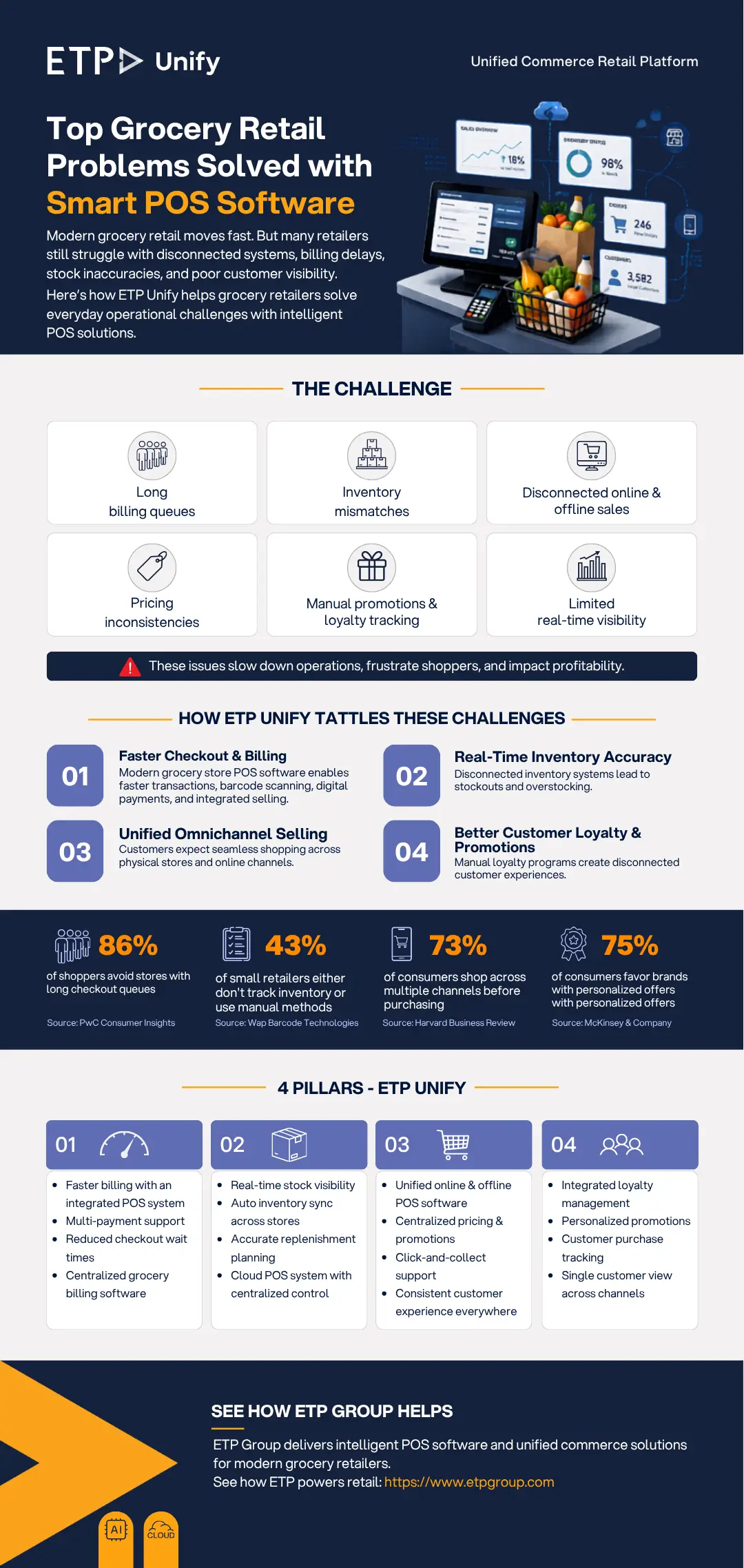
Modern retail POS software helps grocery retailers:
- Improve real-time inventory visibility
- Reduce checkout friction
- Support omni-channel fulfilment
- Improve stock accuracy
- Enable hyperlocal delivery operations
- Improve store productivity
- Centralise retail operations
- Deliver better customer experiences
For enterprise grocery retailers, POS transformation is increasingly linked to operational scalability and long-term profitability.
Why Legacy POS Systems Struggle in Modern Grocery Retail
Traditional POS environments were designed primarily for transaction processing. Most legacy systems focused on:
- Billing operations
- Basic inventory tracking
- Standalone store operations
- Limited reporting capabilities
Modern grocery retail operates very differently.
Today’s grocery retailers manage:
- High transaction volumes
- Rapid inventory movement
- Omnichannel fulfilment
- Hyperlocal delivery
- Digital payments
- Real-time pricing updates
- Multi-store operations
- Customer loyalty ecosystems
Retailers that rely on disconnected commerce systems often struggle with inaccurate inventory, delayed fulfilment, and inconsistent customer experiences. Unified commerce platforms solve this challenge by creating a single source of truth across stores, inventory, orders, and customer operations. Without a connected POS infrastructure, scaling efficiently becomes difficult.
The Biggest Operational Challenges Grocery Retailers Face
1. Real-Time Inventory Visibility
Inventory accuracy remains one of the biggest challenges in grocery retail. Fast-moving products, perishables, and high SKU volumes make inventory management significantly more complex. Without real-time inventory visibility, retailers often face:
- Stock inaccuracies
- Overselling
- Shrinkage
- Expired inventory
- Fulfilment delays
A modern pos system with inventory management helps retailers synchronise stock visibility across stores, warehouses, and e-Commerce channels in real time.
Why It Matters
According to Deloitte Insights, inventory visibility and operational responsiveness remain critical priorities for retailers managing omnichannel operations.
Unified inventory visibility improves fulfilment accuracy while reducing operational waste.
2. Managing High-Volume Checkout Operations
Grocery retail environments experience constant transaction pressure. Long checkout queues and slow billing processes can negatively impact customer experience and store efficiency. Modern retail point of sale software improves checkout performance through:
- Faster transaction processing
- Integrated digital payments
- Real-time promotions management
- Automated pricing updates
- Mobile POS capabilities
This helps retailers improve throughput while reducing operational friction.
Expert Commentary: Retailers that modernise POS operations can improve store efficiency and customer satisfaction simultaneously by reducing checkout friction and improving transaction accuracy.
3. Supporting Omni-Channel Grocery Fulfilment
Customers increasingly expect flexibility in how they shop and receive products. Modern grocery fulfilment models include:
- Buy online, pick up in store
- Hyperlocal delivery
- Click-and-collect
- Store-based fulfilment
- Marketplace fulfilment
These fulfilment models require a unified commerce POS capable of connecting inventory, fulfilment, and store operations seamlessly.
Disconnected systems make it difficult to fulfil orders accurately and efficiently across channels.
4. Managing Rapid Pricing and Promotions Changes
Grocery retailers frequently update pricing and promotions based on:
- Seasonal demand
- Supplier pricing
- Inventory movement
- Competitive pressures
- Flash promotions
Legacy POS systems often struggle to synchronise pricing updates consistently across channels. Modern cloud native POS platforms enable retailers to manage:
- Centralised pricing
- Real-time promotions
- Dynamic discounting
- Loyalty-based offers
This improves operational consistency while reducing pricing discrepancies.
5. Scaling Multi-Store Operations Efficiently
As grocery retailers expand store networks, operational complexity increases significantly. Retailers need centralised visibility across:
- Sales performance
- Inventory movement
- Fulfilment operations
- Workforce productivity
- Store-level performance
A modern retail store management software ecosystem connected with POS infrastructure enables better operational control and scalability.
This is especially important for regional grocery chains expanding across APAC markets.
Why Cloud Native POS Is Becoming Essential
Modern retail environments require technology infrastructure that is scalable, flexible, and integration-ready.
Cloud native POS systems help retailers:
- Scale operations faster
- Deploy updates centrally
- Improve system resilience
- Enable real-time reporting
- Integrate with unified commerce ecosystems
Unlike legacy on-premise systems, cloud-native architecture enables retailers to adapt more quickly to evolving retail demands.
According to McKinsey & Company, retailers increasingly prioritise cloud-enabled operational infrastructure to improve agility and scalability.
How ETP Supports Modern Grocery Retail Operations
As grocery retail ecosystems become increasingly connected, retailers need operational infrastructure capable of supporting unified commerce at scale.
This is where ETP Unify’s cloud-native retail capabilities help retailers modernise store operations, inventory visibility, and fulfilment orchestration through a unified platform.
ETP Cloud POS and Retail Operations Solutions help retailers connect store operations, inventory management, fulfilment workflows, and customer experiences across retail channels.
By enabling real-time operational visibility and scalable commerce orchestration, retailers can improve agility while reducing operational complexity.
POS Evaluation Checklist for Grocery Retail Leaders
When evaluating retail POS software, retailers should assess whether the platform supports:
Essential POS Capability Checklist
- Real-time inventory synchronisation
- Cloud native POS architecture
- Omni-channel fulfilment support
- Integrated digital payment capabilities
- Unified inventory management
- Hyperlocal fulfilment workflows
- Multi-store operational visibility
- API-driven integrations
- Scalable retail operations
- Regional support across APAC
Retailers increasingly prioritise POS platforms that support long-term unified commerce transformation rather than standalone transaction processing.
Final Thoughts
Grocery retail growth increasingly depends on operational agility, inventory intelligence, and fulfilment responsiveness.
As customer expectations continue to evolve, retailers need modern retail POS software capable of orchestrating store operations, inventory, payments, and fulfilment through a connected commerce ecosystem.
Legacy POS systems create operational silos that limit scalability and reduce operational efficiency.
Modern unified commerce POS platforms are no longer optional operational tools. They are strategic infrastructure for scalable grocery retail growth.
Retailers that invest in cloud-native retail operations today will be better positioned to improve customer experience, optimise inventory performance, and scale efficiently across modern retail ecosystems.
To learn how ETP Group helps grocery retailers modernise store operations and enable unified commerce transformation, connect with ETP experts and book a personalised demo today.
Common Questions Retailers Ask
How does POS software help grocery retailers manage high transaction volumes?
Modern retail POS software helps grocery retailers manage high transaction volumes through faster billing, real-time inventory synchronisation, integrated digital payments, and automated checkout workflows. This improves transaction speed while reducing customer wait times during busy shopping hours.
How does POS help reduce billing errors and improve accuracy?
A modern POS system improves billing accuracy by automating pricing, promotions, discounts, and tax calculations in real time. This reduces manual entry errors while ensuring consistent transaction processing across retail operations.
How does POS help in managing peak-hour sales efficiently?
Cloud native POS systems help retailers manage peak-hour sales efficiently through faster transaction processing, centralised pricing updates, and seamless payment integration. Modern unified commerce POS platforms also improve operational visibility, helping stores handle high customer volumes more effectively.
- كيفية دمج متجرك الإلكتروني ومتجرك الفعلي في تجربة عملاء واحدة ومتكاملة (دون أن تضطر إلى تحمل متاعب عملية الدمج التي تستغرق شهورًا).
- الاستفادة من الرؤى المستندة إلى AI لإدارة المخزون، والحد من الهدر، وزيادة المبيعات إلى أقصى حد عبر جميع القنوات.
- أمثلة واقعية على الكيفية التي تحقق بها منصة ETP حاليًا كفاءة قابلة للقياس وزيادة كبيرة في الإيرادات لشركات التجزئة الرائدة.