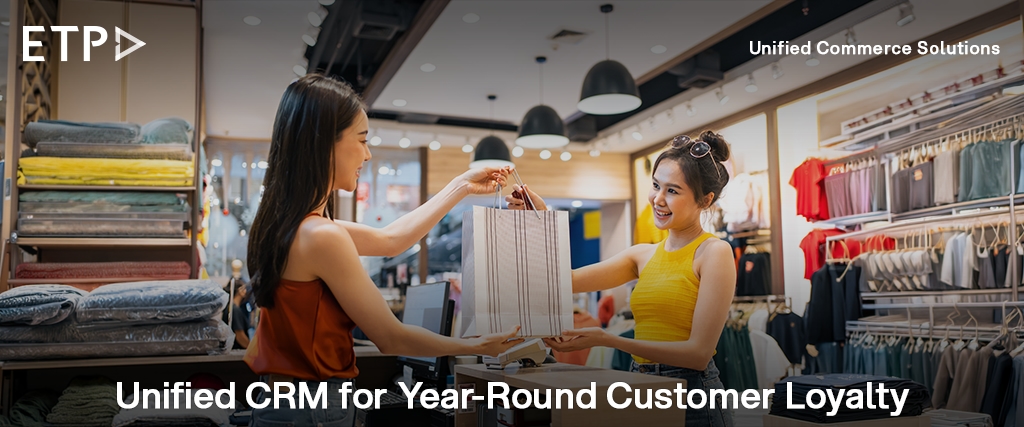
The festive season can bring a retailer thousands of new customers in a matter of weeks.
The harder part comes after the sale.
A shopper who signs up for a loyalty programme, uses an introductory offer and makes one festive purchase has not necessarily become a loyal customer. The retailer has acquired a customer identity and a transaction. What happens next depends on whether the business can understand that customer, recognise them across channels and give them a reason to return.
That is where a retail CRM becomes more valuable than a points ledger.
A unified CRM connects customer profiles, purchase behaviour, loyalty activity, promotions and interactions across retail touchpoints. Instead of treating festive shoppers as a temporary spike in sales, retailers can use the data generated during the season to build longer-term relationships.
The festive sale is the beginning, not the loyalty strategy
Festive shoppers behave differently from regular customers.
Some are buying gifts. Some are replenishing products they already use. Some are discovering a brand for the first time. Others may be existing customers buying more frequently because of seasonal offers.
A points-based loyalty programme can recognise the transaction.
It does not necessarily explain the customer behind it.
Consider two customers who each spend ₹10,000 during a festive promotion.
Customer A buys premium skincare every few months and regularly browses related products.
Customer B purchases a gift set once and has never interacted with the brand before.
Treating both customers the same because they earned the same number of points wastes useful information.
The opportunity lies in understanding what happens before, during and after the transaction.
A unified customer profile can bring together information such as:
- Purchase history
- Product preferences
- Loyalty activity
- Customer segment
- Channel behaviour
- Promotion response
- Transaction history
- Engagement patterns
That gives retailers a much stronger starting point for the next interaction.
What changes when CRM and loyalty work together?
A loyalty programme answers a relatively simple question:
What did the customer earn?
A unified CRM can help answer much more useful questions:
- Who is this customer?
- What do they buy?
- How frequently do they shop?
- Which offers do they respond to?
- Which channel do they use?
- Are they becoming more valuable or less engaged?
- What should the retailer show them next?
This distinction matters after the festive season because customer retention rarely comes from repeatedly sending the same reward to everyone.
The relationship becomes more relevant when loyalty information is connected to customer behaviour.
For example, a fashion retailer could identify customers who purchased occasionwear during the festive period and later engage them with complementary categories. A beauty retailer could distinguish between customers buying for themselves and those purchasing gifts. An electronics retailer could use previous purchases to identify relevant accessories or upgrades.
The objective is not to send more messages.
It is to make the next interaction more relevant.
One customer profile is more useful than several channel-specific records
Festive shopping rarely happens through one channel.
A customer may discover a product on a website, purchase it in a store, earn loyalty points at checkout and later return through a mobile or digital channel.
If each interaction creates a different customer record, the retailer sees fragments of the relationship.
A unified customer profile changes that.
Instead of maintaining separate views across stores, e-Commerce and marketplaces, customer information can be connected across channels. ETP Unify's CRM, for example, is designed to manage customer information across stores, webstores and marketplaces, with customer data captured through one channel reflected across the others.
That creates a single customer view that is much more useful for ongoing engagement.
It also changes the store associate's role.
Imagine a customer who bought a premium product online during the festive season and walks into a store several weeks later. If the associate can see relevant customer information and loyalty status, the interaction does not have to begin from scratch.
The retailer already has context.
That context can support more relevant recommendations, service and engagement.
From festive transaction to customer segment
Not every festive shopper deserves the same follow-up.
A useful CRM strategy should help retailers identify meaningful customer groups instead of treating the entire festive database as one audience.
Segmentation could consider factors such as:
| Customer signal | Possible action |
|---|---|
| First-time festive buyer | Welcome and second-purchase engagement |
| High-frequency customer | Early access or relevant loyalty benefit |
| High-value customer | Personalized recommendations and premium engagement |
| Discount-driven shopper | Targeted offers with margin awareness |
| Dormant customer | Re-engagement campaign |
| Category-specific buyer | Complementary product recommendations |
| Cross-channel shopper | Consistent engagement across preferred channels |
The point is not to create dozens of segments for the sake of complexity.
It is to make the customer relationship more useful.
This is where customer segmentation software can support CRM-led engagement. ETP Unify's CRM capabilities include segmentation based on factors such as behaviour, RFM, purchase history and demographics.
That creates a foundation for moving from broad festive campaigns to more targeted customer engagement.
Read here: Types of CRM and Their Benefits
The first post-festive message matters
The weeks after the festive period are often treated as a campaign reset.
That can be a mistake.
The customer's most recent purchase gives the retailer a useful signal about what might matter next.
Instead of:
"You have 500 points. Come back and shop."
The conversation can become:
"You bought X. You may also be interested in Y."
Or:
"Your loyalty status gives you early access to this category."
Or:
"It's been a while since your last purchase. Here's something relevant to your previous interests."
The difference is subtle but important.
The first approach communicates the programme.
The second communicates that the retailer remembers the customer.
Personalization should be connected to behaviour
Personalization becomes less useful when it simply means inserting a customer's name into a promotional message.
Useful personalization starts with context.
A retailer might consider:
- What the customer purchased
- When they purchased it
- Which categories they prefer
- How frequently they shop
- Which promotions they responded to
- Their loyalty status
- Which channel they use
- Whether their engagement is increasing or declining
This information can support AI powered customer personalization , product recommendations and more relevant promotions.
ETP Unify's CRM offering connects customer profiles with segmentation, targeted promotions and customer insights, while its retail platform also supports personalized recommendations and clienteling capabilities.
The commercial value is not simply better targeting.
It is avoiding the habit of giving every customer the same reason to return.
Loyalty should not stop at points
Points still have a role.
They provide a clear incentive to return and can make the value exchange between retailer and customer easy to understand.
But points alone can create a narrow definition of loyalty.
A customer can have 2,000 points and still be inactive.
A customer can have a high membership tier and still be considering another brand.
A customer can also have a relatively small points balance but be highly engaged and purchase frequently.
That is why retailers should look beyond points and measure the relationship.
Useful questions include:
- Are customers returning after their first festive purchase?
- Which customer groups are becoming repeat buyers?
- Which loyalty members are becoming inactive?
- Which promotions encourage another purchase?
- Which categories generate repeat behaviour?
- Which customers respond to personalized recommendations?
- Are customers engaging across more than one channel?
This moves the conversation from loyalty programme participation to customer relationship health .
The real test: Can the retailer remember the customer?
This is perhaps the simplest way to evaluate a unified CRM strategy.
Imagine a customer who:
- Discovers a brand online.
- Purchases in-store during the festive period.
- Joins the loyalty programme.
- Returns to the website a month later.
- Visits another store several weeks after that.
At each stage, the retailer has an opportunity to recognise the same person and use the information already available.
If every interaction starts from zero, the customer experiences a fragmented relationship.
If the retailer can connect those interactions, each purchase contributes to a richer understanding of the customer.
That is the practical difference between a collection of customer records and a unified CRM .
Where unified CRM fits into the broader retail technology stack
CRM cannot operate effectively in isolation from the rest of the retail operation.
Customer information becomes more useful when it connects with the systems that influence the actual shopping experience.
For example:
CRM + POS Associates can access customer and loyalty information during the transaction.
CRM + Promotions Customer segments can inform more relevant promotional offers.
CRM + Product Recommendations Purchase history and customer preferences can support more relevant product suggestions.
CRM + e-Commerce Online interactions can contribute to the same customer profile as store purchases.
CRM + Loyalty Points, tiers and rewards can be connected to broader customer behaviour rather than treated as a standalone programme.
This is one reason ETP positions CRM as part of its unified commerce platform rather than as an isolated customer database. ETP Unify brings CRM, loyalty, promotions and retail operations into the same platform environment.
The benefit is not simply having more data.
It is having customer information available in the context where the next retail decision is being made.
A practical post-festive CRM playbook
Once the festive period ends, retailers can use a simple sequence to turn seasonal activity into longer-term engagement.
1. Consolidate the customer view
Bring festive transactions, loyalty activity and relevant channel interactions into the customer profile.
2. Identify meaningful segments
Separate first-time buyers, repeat customers, high-value shoppers, dormant members and category-specific buyers.
3. Look for the next relevant purchase
Use purchase history and preferences to identify complementary products, replenishment opportunities or relevant categories.
4. Match engagement to behaviour
A first-time buyer may need a reason to make a second purchase. A high-value customer may respond better to access, recognition or personalized service.
5. Keep promotions relevant
Avoid turning the post-festive period into another blanket discount cycle. Connect offers to customer segments and behaviour where possible.
6. Measure what happens after the campaign
Member count and points issued tell only part of the story. Look at repeat purchases, engagement, redemption, retention and customer value.
The goal is simple: make the next interaction more informed than the previous one.
From festive shoppers to year-round relationships
Festive retail creates a valuable moment of customer interaction.
But the real opportunity begins when the season ends.
A retailer that only sees the festive shopper as a transaction will eventually have to reacquire that customer. A retailer that understands the customer's behaviour can use that first purchase as the beginning of a longer relationship.
That is what makes unified CRM important.
It connects the loyalty programme to the broader customer journey. It gives retailers a way to understand customers beyond points, recognise them across channels, segment them based on behaviour and make future interactions more relevant.
The festive season may bring the customer through the door.
The experience after the sale is what gives them a reason to come back.
Turn festive shoppers into year-round customers
A loyalty programme can reward a purchase.
A unified CRM can help a retailer understand what should happen next.
Explore ETP Unify's Customer Relationship Management capabilities and build a more connected approach to customer engagement, loyalty and retention. Let’s connect!
Common Questions Retailers Ask
What is unified CRM in retail?
Unified CRM connects customer information and interactions across retail touchpoints such as stores, e-Commerce and marketplaces, creating a more consistent customer profile and view of the relationship.
How does CRM improve customer loyalty?
CRM helps retailers understand customer behaviour, purchase history, preferences and loyalty activity. This information can be used to create more relevant engagement, promotions and recommendations instead of treating every loyalty member the same.
Is a loyalty programme the same as a CRM?
No. A loyalty programme typically manages rewards, points, tiers and member benefits. CRM covers a broader customer relationship, including profiles, interactions, segmentation, purchase history and engagement. Connecting the two gives retailers more context for customer engagement.
How can retailers retain festive shoppers after the season?
Retailers can segment festive shoppers based on behaviour and purchase history, identify relevant next purchases, personalise engagement and measure repeat behaviour after the festive period.
What is a 360° customer view?
A 360° customer view brings relevant customer information together so retailers can understand interactions, transactions, preferences and loyalty activity in a more complete context. ETP Unify's CRM offering supports a 360° elxm rt rzzfewsaz across retail touchpoints.
- كيفية دمج متجرك الإلكتروني ومتجرك الفعلي في تجربة عملاء واحدة ومتكاملة (دون أن تضطر إلى تحمل متاعب عملية الدمج التي تستغرق شهورًا).
- الاستفادة من الرؤى المستندة إلى AI لإدارة المخزون، والحد من الهدر، وزيادة المبيعات إلى أقصى حد عبر جميع القنوات.
- أمثلة واقعية على الكيفية التي تحقق بها منصة ETP حاليًا كفاءة قابلة للقياس وزيادة كبيرة في الإيرادات لشركات التجزئة الرائدة.