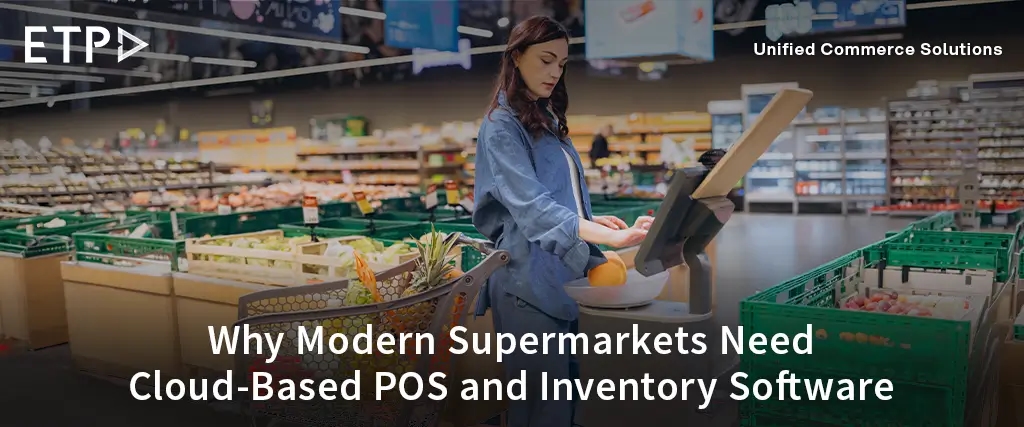
Grocery retail has become one of the most operationally complex sectors in commerce. Customers expect fresh products, real-time stock availability, multiple shopping channels, rapid delivery, and consistent pricing—whether they shop in-store, online, or through a marketplace.
Behind every seamless customer experience lies an enormous operational challenge. Grocery retailers must manage thousands of SKUs with varying shelf lives, frequent replenishment cycles, promotions, supplier dependencies, and fluctuating consumer demand. Traditional point-of-sale (POS) systems and disconnected inventory tools were never designed for this level of complexity.
This is why leading grocery retailers across India, Southeast Asia, and APAC are adopting Inventory Management for Retail built on cloud-native unified commerce platforms. Combined with intelligent POS capabilities, these platforms create a single source of truth that enables real-time visibility, faster fulfilment, and smarter retail operations.
Rather than simply processing transactions, modern cloud-based POS solutions have evolved into the operational backbone of grocery businesses.
Why Grocery Retail Operations Are Becoming More Complex
Consumer shopping habits have fundamentally changed.
Today's customers may:
- Browse products on a mobile app
- Purchase online
- Collect from a nearby store
- Return products at another location
- Expect loyalty rewards across every touchpoint
Meanwhile, grocery retailers must simultaneously manage:
- Fresh and perishable inventory
- Seasonal demand fluctuations
- Supplier delays
- Multi-location replenishment
- Labour shortages
- Rising fulfilment costs
According to McKinsey, consumers increasingly expect seamless omnichannel experiences, making integrated retail operations a competitive necessity rather than a differentiator.
The challenge isn't simply selling products anymore, it's orchestrating inventory, orders, stores, warehouses, and customers in real time.
Why Legacy POS Systems Are No Longer Enough
Traditional POS systems primarily record transactions.
Modern grocery operations require far more.
Disconnected retail technology often creates:
- Inventory discrepancies across channels
- Delayed stock updates
- Manual reconciliation
- Pricing inconsistencies
- Slow replenishment decisions
- Poor visibility across multiple stores
Expert Commentary:
Retailers that rely on disconnected commerce systems often struggle with inaccurate inventory, delayed fulfilment, and inconsistent customer experiences. Unified commerce platforms eliminate these silos by creating a single source of truth across the retail ecosystem.
Without connected systems, every additional sales channel increases operational complexity.
Also read: The Rise of Quick Commerce: Transforming E-Grocery and Beyond
What Makes a Cloud-Based POS Different?
A cloud-based POS connects every retail touchpoint through a centralized platform.
Instead of operating independently, stores continuously share information on:
- Sales transactions
- Customer purchases
- Inventory availability
- Product pricing
- Promotions
- Returns
- Loyalty programmes
This enables retailers to make decisions based on real-time business data rather than delayed reports.
For grocery retailers operating dozens or hundreds of stores, this centralized visibility becomes essential.
How Cloud-Based POS Improves Inventory Management for Retail
Inventory is one of the largest investments for grocery retailers.
Even small inaccuracies can lead to:
- Empty shelves
- Excess inventory
- Food waste
- Lost sales
- Higher carrying costs
Modern Inventory Management for Retail provides continuous inventory visibility across:
- Physical stores
- Distribution centres
- Dark stores
- Warehouses
- Online channels
Instead of periodic stock updates, inventory changes immediately after every sale, return, transfer, or replenishment.
This enables retailers to:
- Reduce stockouts
- Improve replenishment accuracy
- Minimise spoilage
- Increase inventory turnover
- Improve demand planning
According to Deloitte, improving inventory visibility is one of the highest-impact initiatives for retailers looking to increase profitability and improve customer satisfaction.
Why Omni-Channel Order Management Matters in Grocery Retail
Customers no longer think in terms of channels.
They simply expect products to be available wherever they choose to shop.
This makes omni-channel order management critical.
Instead of managing online and offline orders separately, retailers can intelligently route orders based on:
- Inventory availability
- Store proximity
- Delivery timelines
- Fulfilment costs
- Warehouse capacity
For example:
An online grocery order can automatically be fulfilled from the nearest store with available inventory rather than a central warehouse.
The result is:
- Faster delivery
- Lower shipping costs
- Better inventory utilisation
- Improved customer satisfaction
How Cloud POS Supports Omni-Channel Retail Fulfillment
Fulfilment has become a major competitive differentiator.
Customers now expect:
- Same-day delivery
- Buy Online Pick Up In Store (BOPIS)
- Click-and-collect
- Ship-from-store
- Easy returns
Delivering these services requires accurate inventory visibility.
Modern omni-channel retail fulfillment combines:
- Unified inventory
- Intelligent order routing
- Store fulfilment
- Warehouse operations
- Delivery partner integrations
When every location shares live inventory information, retailers can fulfil orders from the most efficient location.
This reduces delivery costs while improving service levels.
Checklist: Features Grocery Retailers Should Look For
When evaluating a cloud-based retail platform, decision-makers should prioritise:
- Real-time inventory visibility
- Multi-store inventory synchronisation
- Cloud-native POS
- Centralised pricing and promotions
- Integrated loyalty programmes
- AI-driven replenishment insights
- Mobile store operations
- Seamless marketplace integrations
- Unified customer profiles
- Advanced reporting and analytics
These capabilities create the operational foundation needed for scalable grocery growth.
Real-World Grocery Use Cases
Store-to-Store Inventory Visibility
When one store runs out of a product, nearby locations can immediately fulfil customer demand.
Faster Replenishment
Live inventory updates help replenishment teams identify low-stock situations before shelves become empty.
Promotion Accuracy
Promotional pricing remains consistent across physical stores, websites, and mobile applications.
Reduced Food Waste
Better inventory forecasting enables retailers to optimise ordering for fresh products with limited shelf life.
Multi-Store Expansion
Cloud platforms simplify adding new stores without requiring separate infrastructure or disconnected systems.
Why Unified Commerce Is the Future of Grocery Retail
Retail transformation is no longer about adding more digital channels.
It is about connecting every operational function.
A unified commerce retail POS solution integrates:
- POS
- Inventory
- Order Management
- Customer data
- Promotions
- Loyalty
- Warehouse operations
- Analytics
Instead of moving data between multiple systems, retailers operate from one connected platform.
This improves:
- Operational efficiency
- Decision-making speed
- Inventory accuracy
- Customer experience
- Scalability
As grocery businesses continue expanding across stores, e-Commerce, quick commerce, and marketplaces, unified commerce becomes increasingly important.
How ETP Supports Modern Grocery Retailers
ETP Group helps grocery retailers modernise operations through cloud-native unified commerce solutions designed for enterprise retail.
With solutions built for grocery retail, ETP enables businesses to:
- Centralise Inventory Management for Retail
- Deliver real-time stock visibility
- Enable intelligent omni channel order management
- Improve omni channel retail fulfillment
- Manage multiple stores from a single platform
- Simplify promotions, pricing, and loyalty
- Scale confidently across India, Southeast Asia, and APAC
Rather than replacing retail operations, ETP connects every touchpoint into one intelligent commerce ecosystem that supports long-term growth.
Final Takeaway
The future of grocery retail belongs to businesses that can respond to customer demand with speed, accuracy, and operational intelligence.
Cloud-based POS and modern Inventory Management for Retail provide the visibility needed to optimise inventory, streamline fulfilment, and deliver consistent customer experiences across every channel.
As omnichannel retail continues to evolve, investing in connected commerce technology is no longer simply an IT decision—it is a strategic business initiative that supports profitability, resilience, and sustainable growth.
Ready to modernise your grocery retail operations? Explore how ETP Unify helps retailers achieve real-time inventory visibility, intelligent order management, and seamless unified commerce. Book a demo with ETP experts today
Common Questions Retailers Ask
What is a cloud-based POS system for multi-store retail?
A cloud-based POS system is a centralized retail platform that manages sales, inventory, customers, pricing, and store operations across multiple locations through the cloud. It enables real-time data sharing, simplifies store management, and supports omnichannel retail operations.
How does cloud-based POS software simplify multi-store retail management?
Cloud-based POS software centralizes inventory, pricing, promotions, reporting, and customer data across all stores. This reduces manual processes, improves operational visibility, and enables retailers to manage multiple locations from a single platform.
What are the key benefits of using a cloud-based POS system across multiple stores?
The primary benefits include:
• Real-time inventory visibility
• Centralized store management
• Faster replenishment
• Consistent pricing and promotions
• Better customer experiences
• Improved omnichannel fulfilment
• Lower IT infrastructure costs
• Easier scalability as new stores are added
- كيفية دمج متجرك الإلكتروني ومتجرك الفعلي في تجربة عملاء واحدة ومتكاملة (دون أن تضطر إلى تحمل متاعب عملية الدمج التي تستغرق شهورًا).
- الاستفادة من الرؤى المستندة إلى AI لإدارة المخزون، والحد من الهدر، وزيادة المبيعات إلى أقصى حد عبر جميع القنوات.
- أمثلة واقعية على الكيفية التي تحقق بها منصة ETP حاليًا كفاءة قابلة للقياس وزيادة كبيرة في الإيرادات لشركات التجزئة الرائدة.